A Vicious Strangeness: The Who – Punk As Fuck

who the fuck 4.jpg

This bootleg could provide an alternative title and cover image for A Band With Built-In Hate, still might if I live long enough for a second edition. Discogs has it listed as a 1982 release, which I thought was fanciful as pretty much everything seemed to have been sourced from Thirty Years of Maximum R&B and subsequent CD reissues, but Jon Savage Tweeted that he’d bought his copy at the tail end of the 80’s (his is on the Brunswick label, mine is on Reaction). Consensus now appears to be early 90’s with a failed 1990 MCA box set as the source. Whatever, it doesn’t much matter, because this is not about rare cuts, instead it is all about surplus value: it’s the object itself that attracts me.

The image is, I’d guess, from around the time of ‘I Can’t Explain’, Spring 1965. Daltrey has moved back from the microphone, leaving a void at the centre that is now filled by the bootlegger’s rubber stamp. Here are four malcontents, utterly at odds with the conventions of pop promotion. Neither smiles or moody introspection, but a combined look that says not only ‘who gives a fuck?’ but more directly ‘who the fuck are you?’ How did that get translated into the pop conversations of the day?

In June 1965, Alan Smith writing about the band in the NME described the ‘four beatsters from Shepherd’s Bush’ as exuding a ‘sort of vicious strangeness’. But that conversation wasn’t taken up by others for another 11 years.

photograph by PTMadden sourced here

photograph by PTMadden sourced here

who the fuck 1.jpg
who the fuck 2.jpg
who the fuck 3.jpg
Brun 1.jpg

Indicator Columbia Noir #3: Johnny O'Clock

What’s In A Name?

noir 1.jpg

Very proud to have contributed a short piece on a firm noir favorite, Johnny O’Clock, for the new Indicator Columbia Noir box set. They have produced another beautiful package. Five Stars

Noir 2.jpg

Below is my original, somewhat longer, unedited piece that I submitted.

Noir 3.jpg

Johnny O’Clock – what’s in a name?

Johnny O’Clock is a gambler who doesn’t gamble; a man who tries to stay above the low-life he has to mix with, a patriarch without a family, and a lover without a faithful partner. In a world without honour he tries to be a just man. He is also something of the dandy. As for the film he gave his name to, it was part of the cycle of post-Depression era crime movies featuring punk hoodlums that all had the name ‘Johnny’ in the title. A partial list: Johnny Apollo (1940), Johnny Eager (1941), Johnny Holiday (1941), Johnny Come Lately (1943), Johnny Angel (1945), Johnny Allegro (1949), Johnny Stool Pigeon (1949),  Johnny One-Eye (1950), Johnny Dark (1954), Johnny Gunman (1957), Johnny Rocco (1958) and Johnny Cool (1963). As always, the Western got in on the action with Johnny Guitar (1954) and Johnny Concho (1956), but they were just sideshows to the main event.

 The cycle followed a long lull in the production of gangster films, a result of the moral backlash to movies such as City Streets, Public Enemy, Quick Millions, and Little Caesar (all 1931).  With the wartime and postwar relaxation of its regimen of self-censorship, Hollywood again exploited the figure of the hoodlum. This time out, however, the gangster’s ethnicity was less readily identifiable as Italian in origin. As a name, Johnny may not, as with Caesar Enrico Bandello (Little Caesar) and Tony Camonte (Scarface, 1932), been specifically Mediterranean in origin, but it could still carry the taint of the inner-city; suggesting a character raised in the tenements, educated on the streets and, depending on the name it was coupled with, still hold ethnic connotations. As the diminutive of John,  ‘Johnny’ was also juvenile, and it was certainly déclassé – entirely lacking in middle-class respectability.

In 1944, Dick Powell was looking for a little bit of that taint of the low to help revitalize his career. He had just turned 40 and the role, as a juvenile romantic lead, that he had once taken in films such as 42nd Street and Footlight Parade (both 1933), was no longer an option. Like Humphrey Bogart a little before him, he reinvented himself as a tough guy, beginning with the Raymond Chandler adaptation Murder My Sweet (1944) and followed by the equally hard-boiled Cornered (1945). The two films had been produced and directed by Adrian Scott and Edward Dymtryk respectively, both would be caught up in the Communist witch-hunts of the McCarthy-era. The third in Powell’s run of tough guy films, Johnny O’Clock was directed and written by Robert Rossen, like Scott and Dymtryk also a one-time member of the American Communist Party. Filmmakers such as these brought to Hollywood a tougher, more authentic view of crime and the city; one that was formed by a direct experience of Jewish American ghetto life. The class politics of Rossen’s film may not be as pronounced as it is in his Body and Soul (1947) or in Abraham Polansky’s Force of Evil (1948), but it’s still right there on the surface, if you care to look.

‘“Johnny O’Clock”, that’s a funny kind of name’ the hotel desk clerk tells J. Lee Cobb’s policeman, Koch. The straight life isn’t for Johnny, he doesn’t get up until nine, PM that is. When more respectable folk are starting to think about going to bed, Johnny’s day is only beginning. His daily routine is an inversion of the good citizen’s and his domestic life is equally strange . . . He’s woken by Charlie, a younger, more obviously, proletarian man, who moves around Johnny’s apartment with an intimate’s familiarity. Over breakfast, Johnny gives him a shirt, in return Charlie gives Johnny a watch engraved with ‘To my darling with unending love’. Before there is time to do a double-take on this queer set up, Charlie explains the gift is from a dame. The relationship between the two men, nevertheless, remains entirely unsettled.

In the hotel lobby, Johnny passes a lecherous eye over a woman, caught in the act by Koch, he tells the policeman it is a habit; giving himself an alibi for a crime unspecified. Crime and sexual deviancy, in the parlance of the day, had long been figured as synonymous in Hollywood’s films, think Tony Camonte’s incestuous desire for his sister in Scarface or Rico’s unspoken love for Joe Massara (Douglas Fairbanks Jr.) in Little Caesar. There are no shortage of women in Johnny’s world, most who make clear their availability, he can even play a convincing paternal role with Harriet (Nina Foch), though Koch misreads his intentions toward her. His one-time lover, Nellie (Ellen Drew), and now wife of his partner in crime, Guido Marchetti (Thomas Gomez), still wants Johnny; she gave him the engraved watch. But it’s with Harriet’s sister, Nancy (Evelyn Keyes), that the romance is played out (or begins to unravel). Nancy is smitten by Johnny from the moment they meet. Inevitably, she is curious about Charlie. ‘He’s my man’ Johnny says. ‘You say that like you’re used to it’, she replies. ‘He’s a guy who just got out of the jug, I give him a place to live. He’d cut off his right arm for me, right up to the elbow’, says Johnny, making the relationship between the two men even less comprehensible to her.

Johnny’s world is covered in a shroud of deception and dissembling. ‘What’s it all mean?’, asks Nancy admiring the Jose Clemente Orozco painting hanging in Johnny’s apartment. He tells her it can mean whatever you want it to mean, and then he tells her it is a reproduction and the fireplace it sits above is also fake and that things, anyway, look better with the lights off. She agrees with him, nothing is to be trusted , and yet she still wants Johnny to say sweet and pretty things and let her pretend they are true.  He kisses her but she pulls away and they then throw words at each other. The scene fades on a kiss and returns with Johnny having changed out of his Prince of Wales check suit into evening attire. What happened in that fade between the costume changes? Did they make love? The look they give each other could be post-coital or it could be so much more innocent. ‘You look nice’, she tells him. ‘A showcase for the suckers’, he says. ‘Let’s make the words mean what they say’, she says.

Dick Powell and Evelyn Keyes admiring his print of Jose Clemente Orozco’s Zapatistas

Dick Powell and Evelyn Keyes admiring his print of Jose Clemente Orozco’s Zapatistas

What’s being teased out here is Hollywood’s time-honoured dance of ambiguity, what happened in the temporal elision is for the audience to decide. The story moves on regardless of whether their relationship went no further than what we actually see. It is the same for what goes on between Johnny and Charlie, are they friends or lovers? The homoerotic charge in their relationship is at times so strongly signalled it surely must have pulled asunder the Production Code tenet to use deniability whenever a film has the potential to become controversial, either sexual or political. But the censor’s notes on the screenplay offer not even the smallest of hints that there was ever any possibility of a misunderstanding of what went on between the two men.

Even after watching Johnny blow his pose of cool detachment, when he learns he’s been betrayed and savagely rips apart the shirt Charlie is wearing, we might have to accept that the erotic charge is not there at all; Johnny is just angry. Maybe seeing their relationship as sexual is just the effect of viewing the film with a modern sensibility; a viewpoint that puts us in a superior position from which to monitor the machinations of the characters. Such a position mirrors that taken by Johnny when he stands on a staircase above the bent copper who is trying to muscle him aside for a spot in Marchetti’s set up, or when he looks down on Guido’s vast living room that seems to have dropped a floor below the apartment’s front door, or when he takes the high vantage point from which he can survey the players in his casino. In these scenes, Johnny appears to have it all under control, though as we learn that is far from being the case. Maybe today’s viewer is just as deceived. Perhaps no one knows what time it really is, not even Johnny O’Clock.

Manhandling Charlie, Johnny rips off the shirt he gave him. Orozco print, once again in the frame. Hats off to Jeff Billington for saving my embarrassment after I mis-identified the painting as being by Diego Rivera (I blame Frank Krutnik)

Manhandling Charlie, Johnny rips off the shirt he gave him. Orozco print, once again in the frame. Hats off to Jeff Billington for saving my embarrassment after I mis-identified the painting as being by Diego Rivera (I blame Frank Krutnik)

Kilburn & the High Roads Play the Penthouse Suite

Kilburn 1.jpg

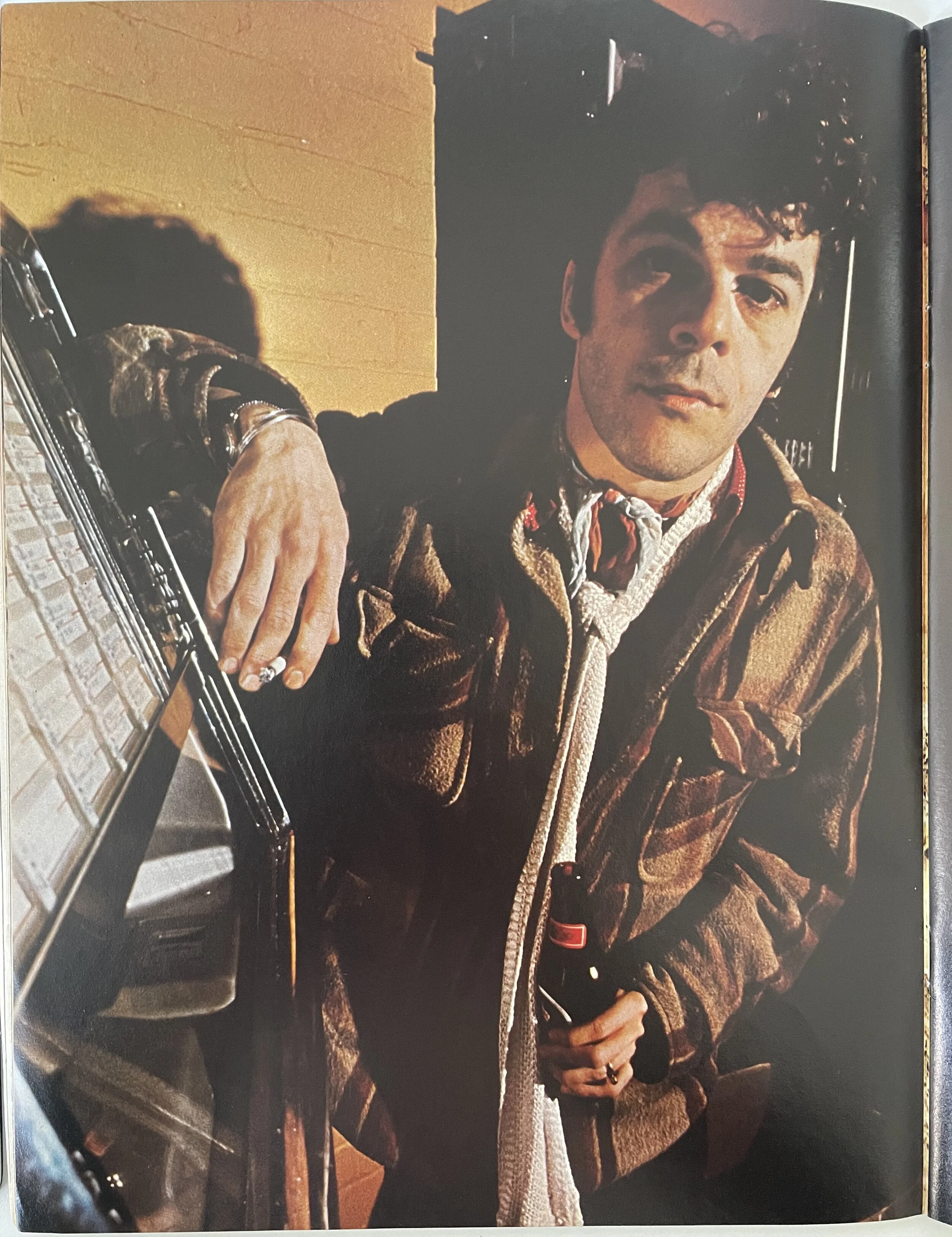
May 1974 and Kilburn and the High Roads are profiled in Penthouse by Steven Fuller. He dishes the dirt on ‘hard times in the world of pub rock’. The photographer is not listed, shamefully, as the images of Ian and the band are wonderful.

Kilburns 2.jpg

Dury discusses his life growing up, polio wards and school, his adolescent sex fantasies (this is Penthouse after all), his love of rock ’n’ roll, and gives a role call of his favorite movies and film stars. Key Largo, Kiss of Death, The Wild One, Somebody Up There Likes Me, The Magnificent Seven, The Vikings and El Dorado. He sent Robert Mitchum a picture he’d done of him playing the town drunk in the latter, the star wrote back. Most of all he likes Lee Marvin:

I did a drawing of Lee Marvin in Don Siegel’s The Killers, I did a silk screen. It was just after he’s been shot, it took me eight days to do the head . . . He’s just about to shoot Angie Dickinson and she begins to plead for her life and he says, ‘Lady, I ain’t got the time.’

Kilburns 4.jpg
Kilburns 3.jpg

Pop Conversations – The Who Meet Nancy Sinatra

Lightning.jpg

You’ll find few advocates for The Who’s ‘Call Me Lightning’. In fact, I’ve never read a word in its defence. Released it seems on not much more than a whim, a stop gap exercise between The Who Sell Out and Tommy or between ‘I Can See For Miles’ and ‘Magic Bus’. It touched #40 in the American charts, but was hidden beneath ‘Dogs’ on its first UK release, so doubly damned as that’s another forgotten 45. It was dismissed by Townshend at the time as ‘unrepresentative’ of the band’s current sound.

For me it is precisely its outlier status within The Who’s oeuvre that makes it a small treasure. I like their quirks, the second side of Ready Steady Who EP and things like ‘Waspman’. Their ephemera keeps the canon fresh, stops it from going stale. Anyway, Townshend was wrong. It was perfectly representative of what the band were doing in 1968, at least an aspect of what preoccupied them. It sits well alongside the Eddie Cochran covers, Johnny Kidd and the Pirates, ‘Young Man Blues’ and the like. ‘Call Me Lightning’ is part of that return they made in ’68 to teenage pop, a restatement of the ethos of rock ’n’ roll as deadly fun.

For many commentators it remains no more than a throwaway homage to Jan and Dean, but like Townshend they too are wrong. The song’s  ‘dum–dum–dum–do-ays’ are more Dion and the Belmonts, New York doo-wop, than California surfing harmonies, equally loved by the band though they might be. The recording has an aggressive masculine spirit that is shared with ‘The Wanderer’ and is not there at all on ‘Little Old Lady (From Pasadena)’ or ‘Dead Man’s Curve’; it trades in a braggadocio wholly avoided by the West Coast duo.

The Who had already borrowed wholesale from Dion’s ‘Runaround Sue’ for their Talmy produced, yet at the time, unreleased novelty record ‘Instant Party Mixture’, which is a hoot; a paean to wacky cigarettes. The subject matter undoubtedly as responsible for its nixed release, coupled with ‘Circles’, as was the copyright implications of its pilfered tune.

The song had been in Townshend’s portfolio since at least 1964, the reason for its return, I like to think, was that it now had contemporary currency. In the Autumn of 1967, Nancy Sinatra released ‘Lightning’s Girl’. Lee Hazelwood’s composition would have been a perfect number for the Ronettes or the Shangri-las, which is to say it is as late to the party as the Who’s tune. ‘Lightning’s Girl’ is a warning from a girl to a boy, whose attention is unwanted, to stay away, otherwise he’ll have to answer to her boyfriend – Lightning.

Here comes Lightning down the street
While you just stand there talking
If I were you I'd start to move
And tell my story walking
About a hundred miles an hour!

If you want to know more about this cat called Lightning, well Roger can tell you:

See that girl who's smiling so brightly
Well I reckon she's cool and I reckon rightly
She's good looking and I ain't frightened
I'm gonna show you why they call me Lightning

And his ‘XKE is shining so brightly’, which if you know your Jaguars, as Pete certainly did, then he also has ‘grace . . . space . . . and pace’, which is another good reason to call him Lightning.

Maybe I’ve misheard what this is all about, but to me it sounds like a great pop conversation: ‘Call Me Lightning’ is best taken as an answer record to ‘Lightning’s Girl’. It’s the kind of exchange pop once had around Big Mama Thornton’s ‘Hound Dog’ with Rufus Thomas’ howling out ‘Bear Cat’ in return, or ‘Judy’s Turn To Cry’ as Leslie Gore’s answer to her own ‘It’s My Party’, or Neil Sedaka singing ‘Oh Carol’ and Carol King responding with ‘Oh Neil’, or, my favourite, The Satintones telling The Shirelles it’s ‘Tomorrow and Always’ in answer to ‘Will You Still Love Me Tomorrow’.

Great pop is always in conversation with itself

song sheet.jpg
LITA.jpg

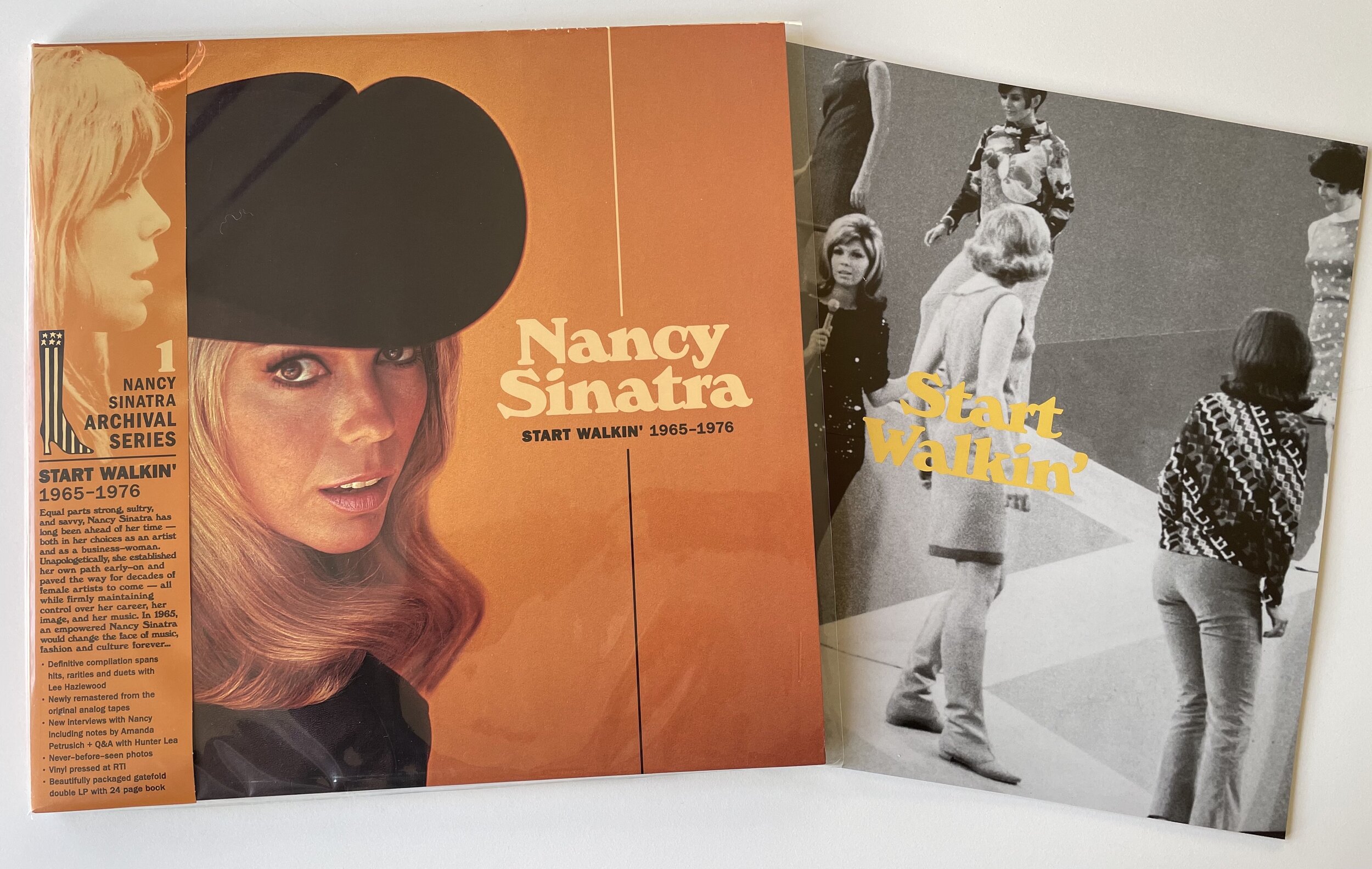
Light In The Attic have just released a double album of Nancy’s best. After having only ever heard these recordings on budget label releases, it is a sonic revelation. As always with LITA the packaging is to die for.

More on Marc Bolan’s Toilette

Back in October ‘20 I posted a piece on Marc Bolan’s brief appearance in a December 1971 edition of Club magazine where he talked about buying clothes and his preference for Onyx aftershave and Fenjal bath oil. If he came across as a little fastidious then at least he was being consistent. Nik Cohn made good use of all of this fussiness in his The Who Generation (see previous post) where he gleaned from his old notebooks the perfect quote from Bolan on Mod bathing habits:

When I was in my mod phase, I used to bathe three or four times a day, change my clothes each time and, when I went out, if I splashed my drink on my shirt-cuff or got the slightest stain anywhere, the whole night was ruined, I had to go straight home and rebuild myself piece by piece. It was my duty to myself. I was a superior being, and I couldn’t fall down.

Meanwhile, elsewhere in the Bolan sphere, Wintergarden publishing, fronting for the Official Marc Bolan Merchandise Company at Easy Action Records, have delivered on a long promised volume of photographs of Stamford Hill’s top face. It is a superlative collection, beautifully produced and designed. See here.

marc.jpg
marc 4.jpg
marc 3.jpg

The Who Generation by Nik Cohn

Circus Magazine’s Pinups No. 4: Collector’s Edition $1.95 (1976)

cover.jpg

Chris Charlesworth recently tipped me off to the existence of this magazine, no surprise it had passed me by given its exclusive American provenance and that Nik Cohn’s journalism is woefully documented and catalogued.

You can read how the project ended up with Cohn on Chris C.’s webpage (here). Cohn’s 7–8,000 words cover the story of the band from their beginnings up to the release of The Who By Numbers and an immanent American tour, which The Who Generation was intended to exploit. 

There are some strange ellipses in Cohn’s history, there’s nothing of any consequence on A Quick One and The Who Sell Out doesn’t even merit a mention; lost too in despatches are ‘I’m A Boy’, ‘Happy Jack’ and ‘Pictures of Lilly’. Much was left in the editor’s waste bin, I would wager. Pity.

Nevertheless, there are things here to thrill Who fans and Cohn-ites alike, he is particularly good on Tommy.

inside.jpg

But this is how it begins:

First of all, The Who were Mods. And Mod, in its own way, was a true pop religion. . .

No question, they [Mods] were most strange. Undersized, very young, white faced with exhaustion, they seemed almost like alien beings, pill-head Martians, newly emerged from time-warp.


Pop!.jpg

Cohn describes his first encounter with the band, at the Marquee on a Tuesday night late in 1964, having been dragged along to see them by Kit Lambert: 

No amount of pre-hype could have prepared me for the furore they whipped up in person. They were, no question about it, the most volcanic group that I had heard in my life. Come to that, I’ve never heard their equal since.

In contrast to the ‘updated beats’ look of the Rolling Stones and all the ‘grubby’ Rhythm and Blues bands that followed:

Out of nowhere there came the Who, the diametric opposites. Their music was as wild as anyone’s, or wilder, but to look at they were positive choirboys. Snow-white Mods, gleaming and precise, in their Union Jack jackets, Mondrian T-shirts, Malibu jeans. It was like reading Clockwork Orange after Howl, watching James Dean after Ernest Borgnine.

Somehow the spotlessness made the underlying violence all the more powerful, the anarchy more seductive. ‘Nice boys committing one murder is far more shocking than a pack of degenerates committing ten,’ said Kit Lambert and, watching the Who that night, it was true, murder was the only metaphor that one could possibly use.


end.jpg

Viv Prince in Novokuznetz

I’ve been crossing paths with The Pretties’ Viv Prince lately, he makes a cameo in Nick Kent’s The Unstable Boys, a model of sorts for the band’s drummer as Phil May was for the singer. I thought of him while reading Nik Cohn’s story of lives lived on Broadway, The Heart of the World, where he says that Russian street gangs named themselves after British beat groups:


Wimp suburbanites chose the Beatles and Rolling Stones; inner-city stylists preferred the Yardbirds or Them. On Novokuz, which must always be the hippest of all, prime icons included John’s Children, the Action, the Troggs.

Sasha himself had been a Fruit Eating Bear, but they were fragile goods and shattered at first contact with Pretty Things who were neighbourhood kingpins. The Things had the deadliest weapons, the sharpest clothes; they looked the most Western. Only the Hi-Numbers dared challenge them.


 Viv had a big role to play in Pretties manager Bryan Morrison’s posthumously published memoir, and frankly the only reason to read what is a otherwise a superficial account of his time as one of the sixties music scene’s prime movers, but it did tip me off to a feature on the band in a 1964 edition of The Sunday Times Magazine, which I found for a pittance on eBay. That’s Viv in the porkpie hat.

ST .jpg

He could do Bo Diddley’s ‘a shave and a hair cut, two bits’ better than any other London sticksman and he gave his instrument a prominence unmatched until Keith Moon appeared, but he also gave to the Pretties’ image a much needed element of menace. Without him they just seem placable, unremarkable even. Regardless of Phil May’s long locks, without Prince mixing things up it’s Dick Taylor’s jazz beard that dominates. It’s as if a woodwork teacher had formed a band with a bunch of willing sixth formers .

Here’s The Pretty Things without Viv Prince, this Dutch 45 picture sleeve featuring his predecessor Viv Andrews

the-pretty-things-road-runner-1965-2.jpg

And here’s what you get when Prince takes up a pose

the-pretty-things-mama-keep-your-big-mouth-shut-fontana.jpg

Until Lee Brilleaux and Johnny Rotten picked over his style book, Viv Prince stood alone in making a sheepskin coat the coolest look on London’s streets. About as anti-Carnaby Street as you could get

viv sheep.jpg
Rotten.jpg

How a sheepskin should be worn, Morlands advert October 1966

Great photo spread for the Pretties in Star Club News (July 1965), Viv looking fine in a Thank Your Lucky Stars tee and ubiquitous sheepskin

1967/8: Summers of Love Blues with The Who and Eddie Cochran

Eddie.jpg

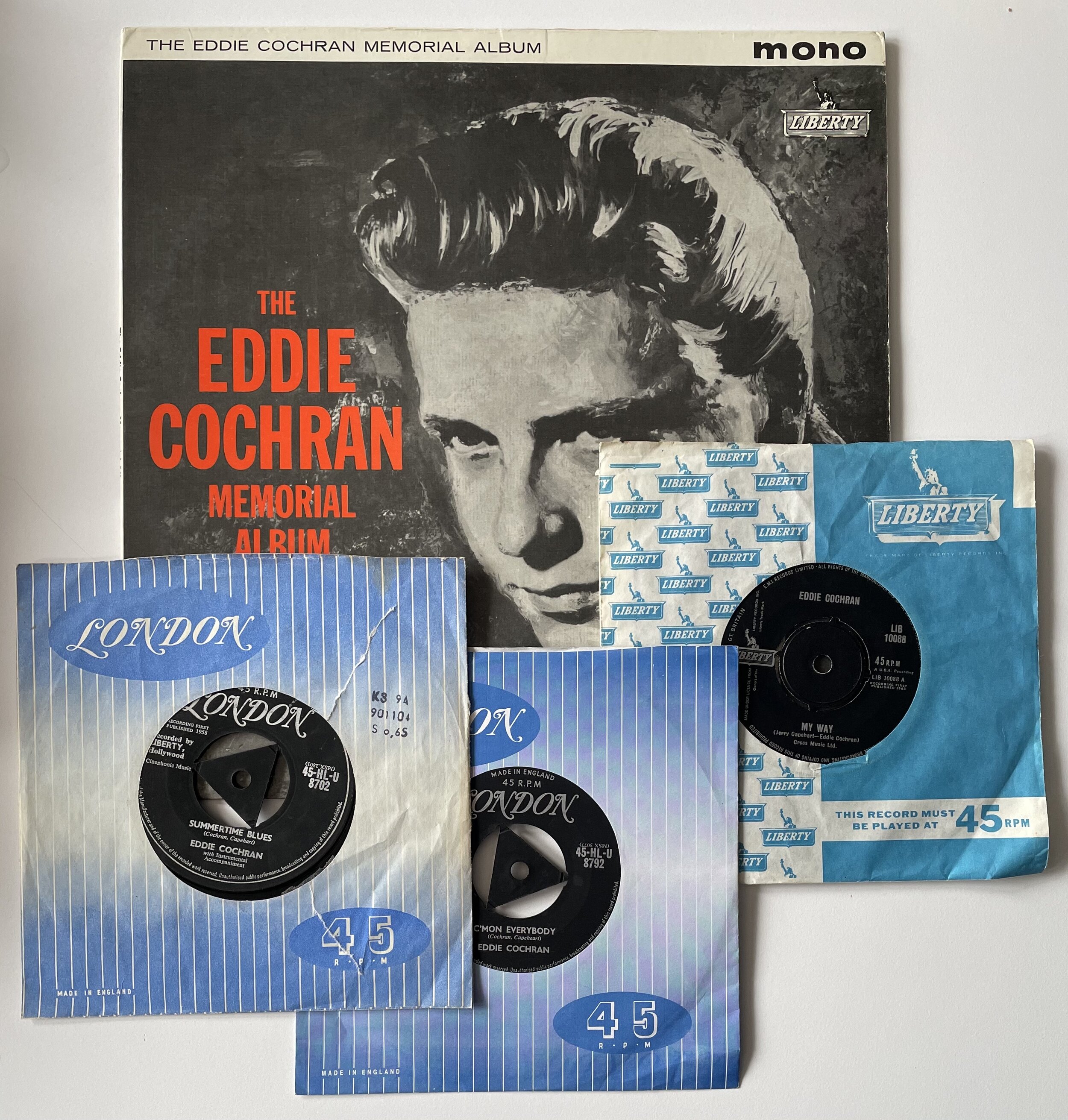
April 1968, The Who have added three, count ’em, three Eddie Cochran numbers to the set-list for the Filmore East gigs – ‘Summertime Blues’, ‘My Way’ and ‘C’mon Everybody’. In 1967, between the release of ‘Pictures of Lily’ in April and The Who Sell Out in December they laid down two studio versions of ‘Summertime Blues’, the first as a potential single, the second, alongside ‘My Way’, for possible inclusion on the album. What was it with The Who and Cochran that led one American journalist to report that Townshend carried tapes of the rocker wherever he goes?

The band were not alone in making a down shift in gears back to rock ’n’ roll as a reaction to the swerve taken during the high-days of psychedelia. The Beatles, the Stones and The Move, among others, felt the curve away from the music’s founding roots was too steep and attempted a recalibration, but if The Who were following a general trend then their latching on to Cochran, if not unique, had a depth and reach that exceeded the likes of Blue Cheer.

Nik Cohn thought Cochran played ‘pure rock’, whatever that might be, and he was ‘a composite of a generation . . . a generalised 50s blur’. Greil Marcus considered ‘Summertime Blues’ the ‘grammar book of rock ’n’ roll language’, but you might say the same of Gene Vincent and ‘Be-Bop-A-Lula’. Or maybe not, Vincent was too much of a greaser, much more of the pool hall punk than Cochran, whose performances and songs spoke more clearly to a suburban teenage dissatisfaction than to an urban disaffection. Cochran wrote teenage anthems, he worked the high school beat and the soda hop, Vincent came from the world of juke joints and honky tonks, he smelt of reefer and whiskey. In Cochran’s world, dad busted up your fun. Vincent was sui generis, without parents: it is unimaginable to think of him sitting down to Sunday dinner with mom and pop. The differences are there in their individual performances in The Girl Can’t Help It. Cochran is projected into the family home via the television set, Gene Vincent and His Blue Caps are playing in some downtown rehearsal space uninvited to the party.

You might pull on Vincent’s leather jacket, like countless British rockers did, but you could only mirror back his stance and hang on to the microphone stand in a pose that mimicked him. You couldn’t better Gene Vincent at being Gene Vincent. But Cochran, his stance and pose, The Who could own. They could remake him to fit their purpose, with Townshend incorporating, as Charlie Gillett wrote, the rock ’n’ roller’s ‘chunky, resentful guitar’, while Daltrey and Entwistle could play teenage parts with a knowing wink as a counter to Moon’s arrested development.


g and e.jpg
a very rare tri-centre promo edtion . . . a homage to the original London release I believe

a very rare tri-centre promo edtion . . . a homage to the original London release I believe

Graeme Thomson's Mail on Sunday Review

Mos.jpg

It could have gone all so horribly wrong, seven books and my first review in the mainstream media, but I survived. So, Graeme Thomson, thank you, especially for the great pull quotes:

‘The best parts of the book mirror the best of The Who, fizzing with ideas and connections’


‘This book vividly reanimates the nasty, transgressive scene-shaping thrill of their beginnings’


Doing Rock 'n' Roll Time with Kris & Roger

I’ve been doing a little research on Kris Kristofferson on the way to writing about Pat Garrett and Billy the Kid and the soundtrack to my ramblings is a new Ace CD of notable covers of the main man’s songs, For The Good Times. Among the familiar, Johnny Cash, Jerry Lee Lewis, Sammi Smith and Ray Price, a tune called ‘Rock n Roll Time’ stopped me in my tracks, who the fuck is this doing The Clash doing Kristofferson? Well colour me surprised, it’s Byrdman Roger McGuinn. But know this . . . it is produced by Mick Ronson, 1976. This truly is proto punk. Turn this up!

Kris and Tony.jpg

Hank Ballad didn’t make the cut for the Ace CD but it should if they ever get around to doing a second volume, Memphis’ Dixie Flyers backing up Mr. Twist . . .

ace.jpg

Hilton Valentine – RIP

animals.jpg

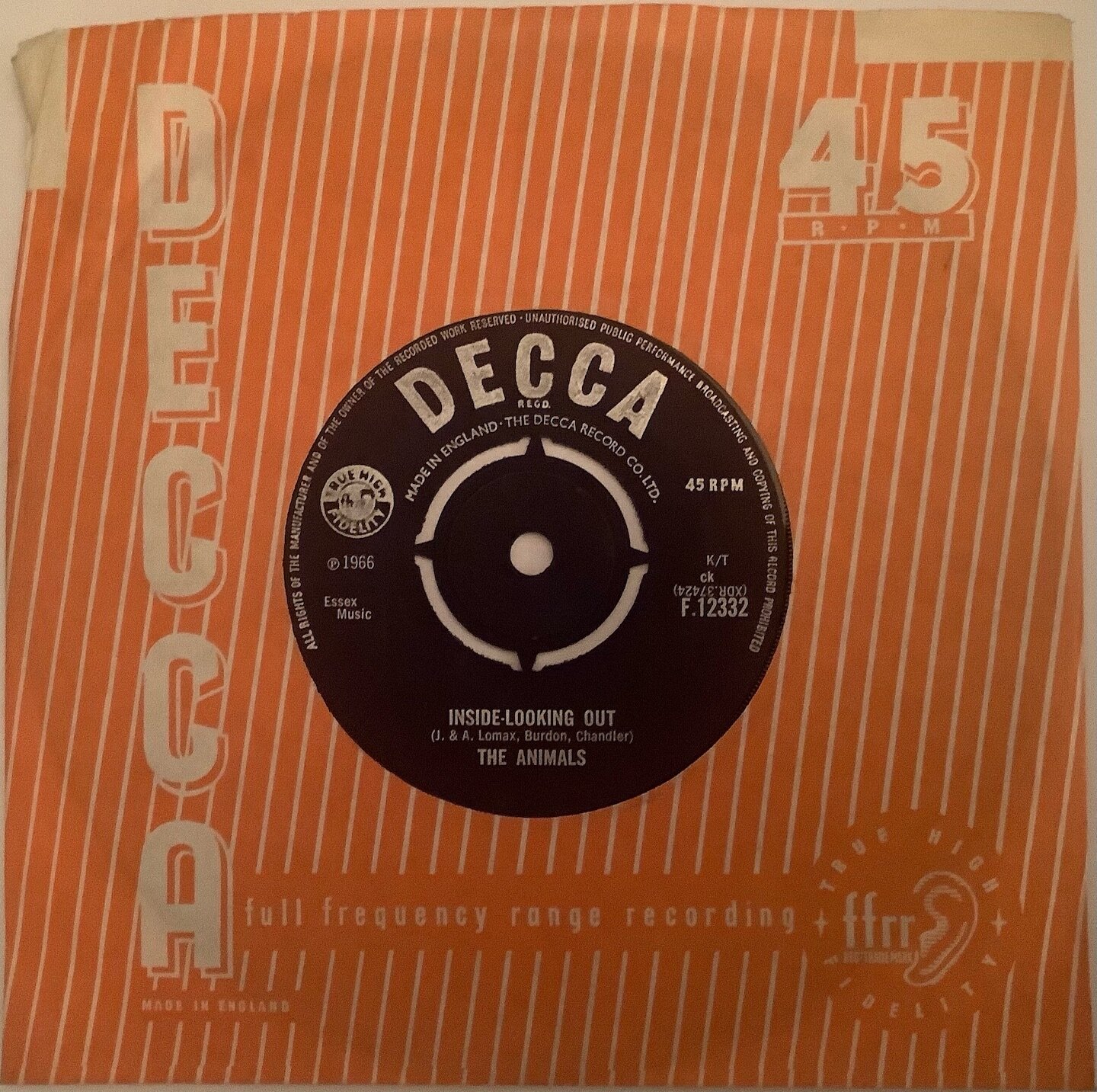
Remembering Hilton Valentine, guitarist and founding member of The Animals who has died at age 77. Although he achieved worldwide fame in 1964 with ‘House Of The Rising Sun’, during a recent interview Hilton Valentine named ‘Inside Looking Out’ as one of his all time favourite recordings with The Animals. Recorded in 1966, it encapsulates both the atmosphere of every smoke filled dancehall they ever played in as well as the sheer power of a pile driving beat that put British bands at the epicentre of the struggle for social change that became the hallmark of the sixties. One of the all-time toughest Brit 45’s ever recorded. People were dancing to it then, people are still dancing to it now. With love and respect we thank you Valentine Hilton.

Eddie King

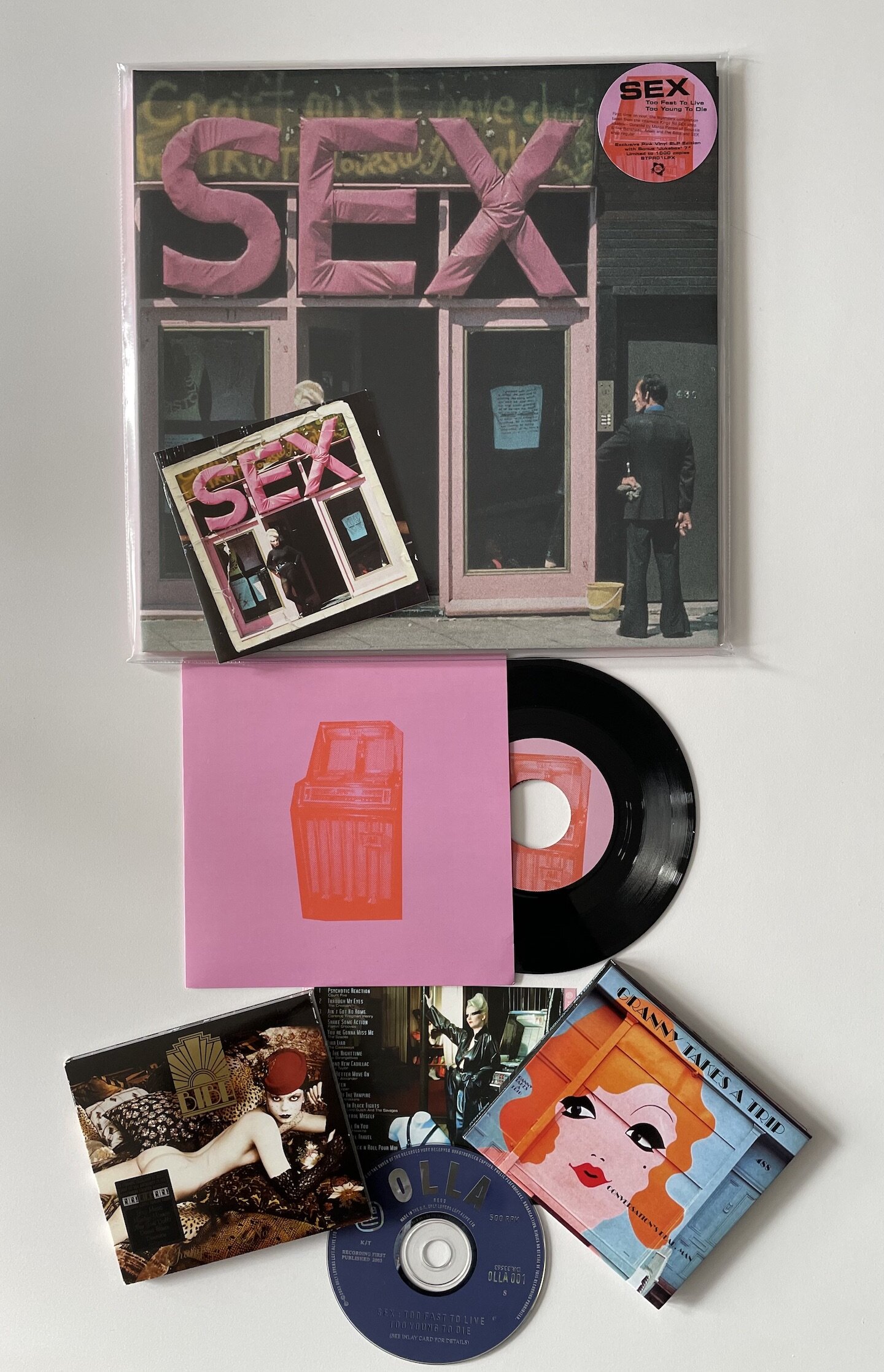
Sex: Too Fast To Live Too Young To Die

Sex.jpg

Toward the end of last year I chanced upon the news that one of my favourite CD compilations was finally getting the deluxe vinyl treatment, Marco Pirroni’s 2003 collection of jukebox picks from 430 King’s Road. The mix of British RnR (Vince Taylor, Lord Sutch, Joe Meek), Beat (Troggs), Freakbeat (The Creation), a slew of 60s Nuggets, (Spades, Sonics, Strangeloves, Castaways, Count Five), some classic RnB (Clarence ‘Frogman’ Henry, Arthur Alexander, Screamin’ Jay Hawkins) is filtered by the more contempary sounds of Alice Cooper’s ‘Eighteen, Flamin’ Groovies’ ‘Shake Some Action’ and The Modern Lovers ‘Roadrunner’, and then topped off by Johnny Hallyday and Loretta Lynn. It’s not a particularly eclectic blend, or maybe that’s just hindsight provided by living in a post-Nuggets world and the fact that that so many of the featured bands and tracks came to have an importance in 1976/77 – dj’d at gigs and one or other of the tracks covered by just about any wannabe band moving out of the nation’s youth clubs and into the city. Still, I’m left asking where McLaren found a copy of The Spades (pre-Thirteenth Floor Elevators) ‘You’re Gonna Miss Me’/’We Sell Soul’, both sides featured here. Originals go for four-figure numbers these days, though it did get booted circa 1976. Perhaps he got a repro copy from Marc Zermati at his L’Open Market in Paris or at one of Ted Carroll’s Rock On outlets?

rock on.jpg

The track selection on Sex isn’t that distinct from that offered on the 2008 Ace CD that celebrates Carroll’s shops and market stores. There’s nothing on that set that McLaren wouldn’t have approved of, including as it does Jerry Byrne’s ‘Lights Out’ that forms one side of the bonus 45 that comes with the first 1000 copies of the new vinyl edition (the flip is Ian Hunter’s sublime ‘Once Bitten, Twice Shy’). The difference is that the Ace CD has less of the English part of the equation, and none of the camp asides that Sutch, Meek, Hallyday, Lynn and Jackie and The Starlites provided on the Sex jukebox. Rock On has that very British addiction to a certain strand of authenticity, that still appeals to me, but it was one that McLaren eventually rejected when he dumped the Teddy Boy clientele and the fifties retro mode and, post his encounters with the New York Dolls, switched to Sex and the Sex Pistols.

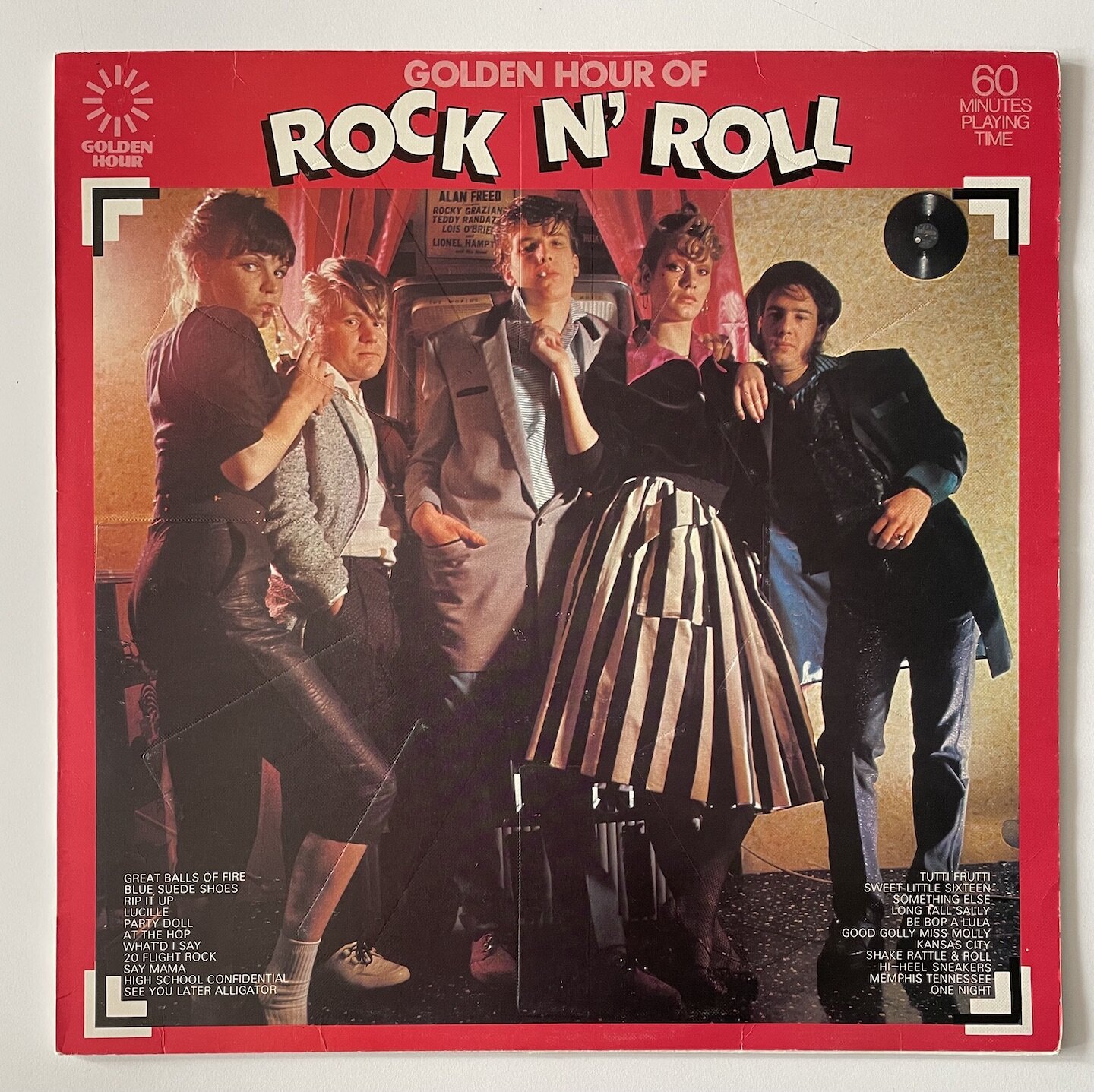
1973 album of RnR covers by anonymous session musicians, but does credit the stylist –  ‘Clothes: Courtesy of “Let It Rock” 430 Kings Road London’. Who are the models, because I bet they never drank at the Black Raven?

1973 album of RnR covers by anonymous session musicians, but does credit the stylist – ‘Clothes: Courtesy of “Let It Rock” 430 Kings Road London’. Who are the models, because I bet they never drank at the Black Raven?

The deluxe vinyl edition with the bonus 45 can only be bought from Hackney’s Stranger than Paradise, a store named after one of my most beloved of films. Here. Perhaps they’ll also release on vinyl Marco Pirroni’s other two Only Lovers Left Alive collections Granny Takes a Trip: Conversation’s Dead, Man and Biba; Champagne and Novocaine.

John Peel Helps The Who Sell Out

You can see the whole disruptive dynamic of the band on display here. Other than that, the best part is when Townshend talks about the difference between record buyers and a live audience. His observation is up there with Jean-Paul Sartre when, after a visit to the States in 1946, he explained how the top ten was not a representation of any one’s taste:

. . . if he listens to the radio every Saturday and if he can afford to buy every week's No 1 record, he will end up with the record collection of the Other, that is to say, the collection of no-one

A Band With Built-In Hate

A Band with Built-In Hate_Jkt_PRESS1024_1.jpg

Dust jacket ahoy! Book should be in the shops in March.

With impressive eloquence, A Band with Built-in Hate situates '60s Britain's most volatile and incendiary group at the heart of pop's wild vortex, its sonic assaults on the class system and the cultural status quo. Stanfield digs brilliantly into the Who's transgressions, their up-ending of entertainment, their transmuting of pop music into art-rock and proto-punk. He can see for miles.

Barney Hoskyns, author of Lowside of the Road: A Life of Tom Waits and Major Dudes: A Steely Dan Companion

The best book on the Who. Stanfield understands that they were built entirely around opposition - they didn’t want to be the Beatles or the Stones; they didn’t even want to be the Who most of the time. He smartly states the case for peak Who as transgressive, how their clashing obsessions with primitive rock’n’roll and sociological statements made them so exciting. He also wisely concentrates on their peak years, before pop solidified as rock, when the Who were the closest thing to pop art British music has ever produced.’

Bob Stanley, founding member of St Etienne and author of Yeah Yeah Yeah: The Story of Modern Pop

Marc Bolan Likes Chet Baker

Real Bolan.jpg

A 1972 Record Mirror Special introduces the ‘real Marc Bolan’, and interviews his mum and dad to boot. Tracking through his biography, from his appearances in Town magazine to around the release of Electric Warrior, the Special offers a fine selection of archive photographs and titbits from old press releases, including the following used to promote ‘Hippy Gumbo’:

Marc Likes: £9000 cars. Marc Dislikes: £8,000 cars. Taste in Music: Rock and roll and Chet Baker. ‘I’ve never heard Chet Baker, but he looks great. I have all his album covers’.

Spoken like a true Mod.

The Fall – from Manchester to Memphis

fall 1.jpg

Rock ‘n’ roll speaks in a secret language; its gnomic prayers and coded lamentations passed on from one disciple to another, which is why Bob Dylan posed with albums by Lotte Lenya, Ravi Shankar, The Impressions, Eric Von Schmidt and Robert Johnson on the sleeve of Bringing It All Back Home. Frankly, no one had to work hard to decipher the meaning Dylan wanted to set in train with that set of references. Mark E. Smith was no less adroit in his ability to speak in tongues, though truth be told his objects of devotion had escaped me for the best part of four decades; revealing themselves only after a recent binge on the band’s early catalogue.

Fall 2.jpg

Hiding in plain sight for all these years, up in the top left hand corner on the rear of Grotesque (After the Gramme) – part of a collage of snaps of the band – Smith stands next to a Pickwick Records spinner rack (liberated from the street outside Salford’s Radio Rentals, I’ll wager). On view is Elvis’s 40 Greatest Hits (inc. 18 #1s), released on the budget Arcade label in 1974 and at the time, and for years after, utterly ubiquitous. Above Elvis is a Charly Records compilation of Charlie Feathers’ 50s sides, Rockabilly’s Main Man – released a year before Grotesque in 1979 – a cult taste moving up fast into the mainstream courtesy of such disparate proselytisers of the new beat as Crazy Cavan and The Cramps . ‘Rockabilly is a hot sound just now’, wrote Martin Hawkins in his sleeve notes, ‘and getting hotter’. On top of the spinner stack is Tav Falco and the Panther Burns debut release; a self-produced EP that in 1980 would have been known only to a very small handful of initiates and hip priests.

Fall 3.jpg

The EP had zero distribution outside of Memphis and a first pressing of only 250 copies. I suspect Geoff Travis gave Smith a copy of the disc, which he would have obtained while negotiating and preparing the release on Rough Trade of Panther Burns’ album Behind the Magnolia Curtain the following year. Smith must have thought he’d found a fellow traveller in Tav Falco, who was also pushing the rattle n’ throb of rockabilly as far away from the revivalists as you could possibly get. His record could function as a touchstone for The Fall, and certainly worth putting at the top (or bottom) of a Memphis hierarchy. Beholden to Elvis, The Fall and Panther Burns are the true spiritual heirs to Charlie ‘One Hand Loose’ Feathers – fiery jacks one and all.

Marc Bolan Uses Fenjal Bath Oil

Marc.jpg

Marc is wearing a print crépe shirt, £6; satin print blazer, £20; satin stripe trousers, £5.50, all from Alkasura. He uses Onyx aftershave, £1.20 and Onyx shaving foam, 95p., by Lentheric. Fenjal bath oil, 49p.

Club ( a ‘gentleman’s magazine’) ran a feature called ‘Who Wears What’ in their December 1971 edition, Kenny Everett, Legs Larry Smith, David Hockney and Chelsea stiker Chris Garland found themselves pitted against Marc Bolan. They didn’t stand a chance. . . Bolan, still philosphically a Mod, said ‘The way I dress is only for me . . . Sometimes I spend a couple of thousand pounds on clothes . . .’