Pop Art Interiors: Pontiac Club – Zeeta House, Putney

‘Pop-art, Op-art and all that similar stuff is beginning to leak out of the avant garde galleries into the field of interior design. The doors open on a beat club in Putney tonight which aims to be the place where all things are happening in the Southern area’.

Charles Greville, Daily Mail (May 27, 1965)
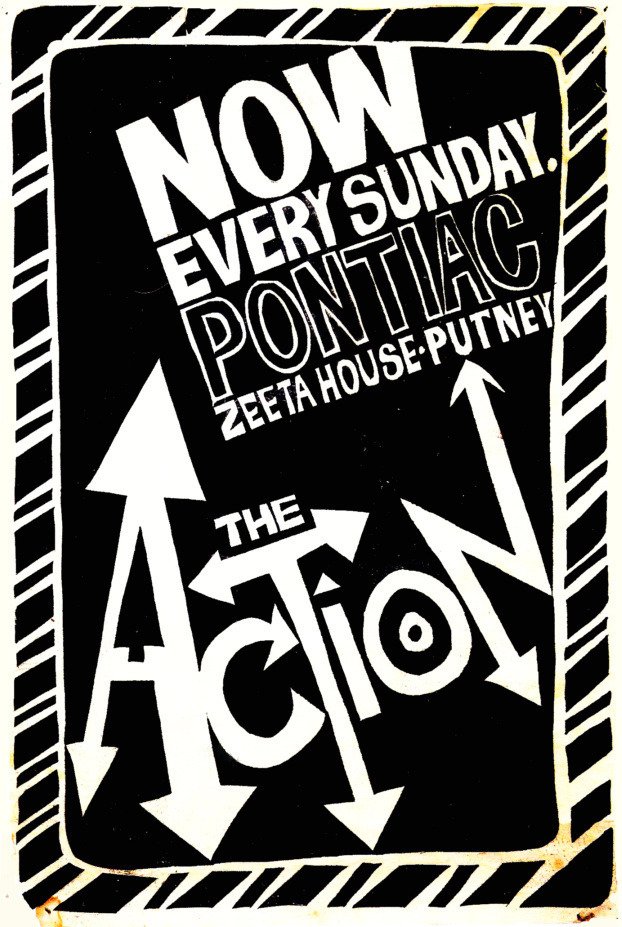
From Ian Hebditch and Jane Shepherd’s essential, The Action: In The Lap Of The Mods (2012). Order [here]

Melody Maker (July 31, 1965)
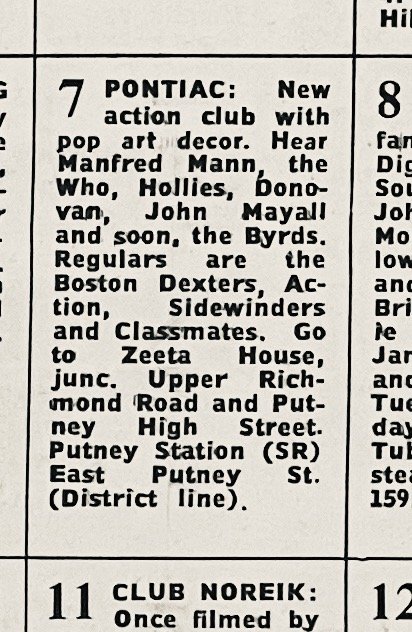
As much as it was the name that caught my pop-eye – ‘Pontiac Club, Zeeta House, Putney’ – what piqued my interest was the description in Melody Maker’s 1965 cut-out-and-keep guide to London’s beat clubs. It was No.7 on the map: ‘A new action club with pop art décor’. With The Who as one of the named attractions, it was clearly part of the on-going phenomenon of Pop Art into Pop, that ‘leak’ which the Daily Mail’s Charles Greville was referring to when he visited the club on the day of its opening and one then being heavily exploited and led by the ’Bush Boys.

A cursory Google and a quick browse in books you might have thought the club would be discussed in gave up little but a membership card or two, music press adverts and a list of club dates on Garage Hangover [here], which suggests the venue operated for not much more than a year between May 1965 and June 1966.

The club was located in a building designed for the Zeeta Cake Co. that opened in 1938 at the junction of Upper Richmond Road and Putney High Street. There was a smoking room in the basement, the ground floor consisted of shops, a restaurant on the first floor, a ballroom and banqueting hall on the second floor and a bakery and staff offices on the third and fourth. The ballroom had a sprung oak floor with columns propping up a domed ceiling. [For a history of the building see here].

This sequence of images have been copied from RIBA’s webpages

First floor restaurant

Main staircase

The ballroom

Daily Mail (May 27, 1965)

Penny Valentine in Disc listed Johnny and Harvey Riscoe as the club’s owners, but in other accounts Paul Waldman is named as the owner (a June advert in Melody Maker announced the club was ‘now under new management’). The club had been advertising shows at least as early as March 17, but in any event it was Waldman who had invited art students to help redesign the club’s interior. Under the patronage of Sir Hugh Casson, Professor of Interior Design at the Royal College of Art between 1955–75 and director of architecture for the Festival of Britain, students Richard Beal and Alan Saunders were joined by Peter Dale from Kingston College of Art. They painted over the large mirrors that surrounded the dance floor with comic book figures, such as Superman and Iron Man. . . . Donovan was the opening night’s attraction, May 27.

The Kensington News & West London Times (June 4, 1965)

It’s Art Deco interior refashioned for a Pop Art age is a precursor, I think, to Biba’s takeover of Derry and Toms department store in 1973, both buildings were designed by the architect Bernard George (1894–1964)

Biba’s Rainbow Room, where the New York Dolls played in 1973, features a similar domed ceiling design.

Penny Valentine, Disc Weekly (July 3, 1965)

In Disc Weekly, Penny Valentine, described the Pontiac as a ‘sort of pop art club. The walls have been painted by two art students and look like something out of a nightmare with people like Superman in eight foot colour’. Beyond its Pop Art decorations, the appeal of the club was its size, holding over a thousand attendees, it was open Wednesdays through to Sunday, from eight to two in the morning and was unlicensed.

The club instantly became a feature on the city’s gig circuit, offering West London’s premier location after the closing of the Crawdaddy Club at the Richmond Athletic Grounds in July 1965.

Penny Valentine, Disc Weekly (July 24, 1965)

When they played the Pontiac at the end of July, Penny Valentine wondered ‘how many guitars and mikes The Who will demolish tonight’. The band exceeded themselves and even Penny’s expectations, as Andy Neill and Matt Kent note in their chronicle of the band. The Who only managed to play one of their two scheduled sets as they blew out the PA. They did, however, perform ‘My Generation’ for possibly the first time. Though it seems they just missed out on being filmed at the club, acts appearing later in the week ended up playing before cameras even if their efforts were mostly left on the cutting room floor.

Record Mirror (August 21, 1965)

At the start of August, Clarendon Productions spent time at the club shooting scenes for a sequence to be used in one of four thematically linked short films on ‘Romance and Courtship Throughout The World’.  Record Mirror listed possible appearances from John Mayall’s Bluesbreakers (featuring Clapton), Graham Bond and, club regulars, The Boston Dexters (The Action would later have the residency). Patti Boyd’s sister, Jenny, played the film’s lead.

The short film eventually appeared in 1966 under the title of Reflections On Love. Approximately three minutes into the eleven minute film ‘the girl’ visits the Pontiac. You can see the double doors, with the star insignia used on the club’s membership card, open onto the ballroom, which is crowded with dancers. The Bluesbreakers are playing but there is no synced audio from the band or anything from arranger Johnny Spence who had been listed as a contributor – the version on YouTube has Kula Shaker delivering the soundtrack. The club sequence has a set of visual effects, colour saturation, that blurs band, dancers and the club’s interior, and is, unfortunately, not much of a rival to Blow Up’s Ricky-Tick recreation, even if the dancers are more animated. It lasts a little less then a minute but some small compensation is that the ballroom’s mirrored walls, columns and ceiling can all be briefly seen.

Though it seems to float freely around on Facebook this is musician Steve Van-Deller’s membership card, he still plays in the Putney area – Google him. He recalls the Bluesbreaker’s gig with Clapton and T-Bone Walker as two standout shows at the venue. In an email to me Steve wrote:

‘I remember being very impressed with the interior, but I was only 15 going on 16 at the time . . .The club had a great vibe . . . The Action were brilliant when they had their Sunday residency, and the Boston Dexters were a great soul covers band too’. 

‘We are creating, a modern-day pop image in our own style’, one of the designers told The Kensington News and West London Times, ‘We made pop art into an interior, instead of leaving it on a white canvas’. Peter Dale added that he would be ‘rather pleased if people don’t like it’.
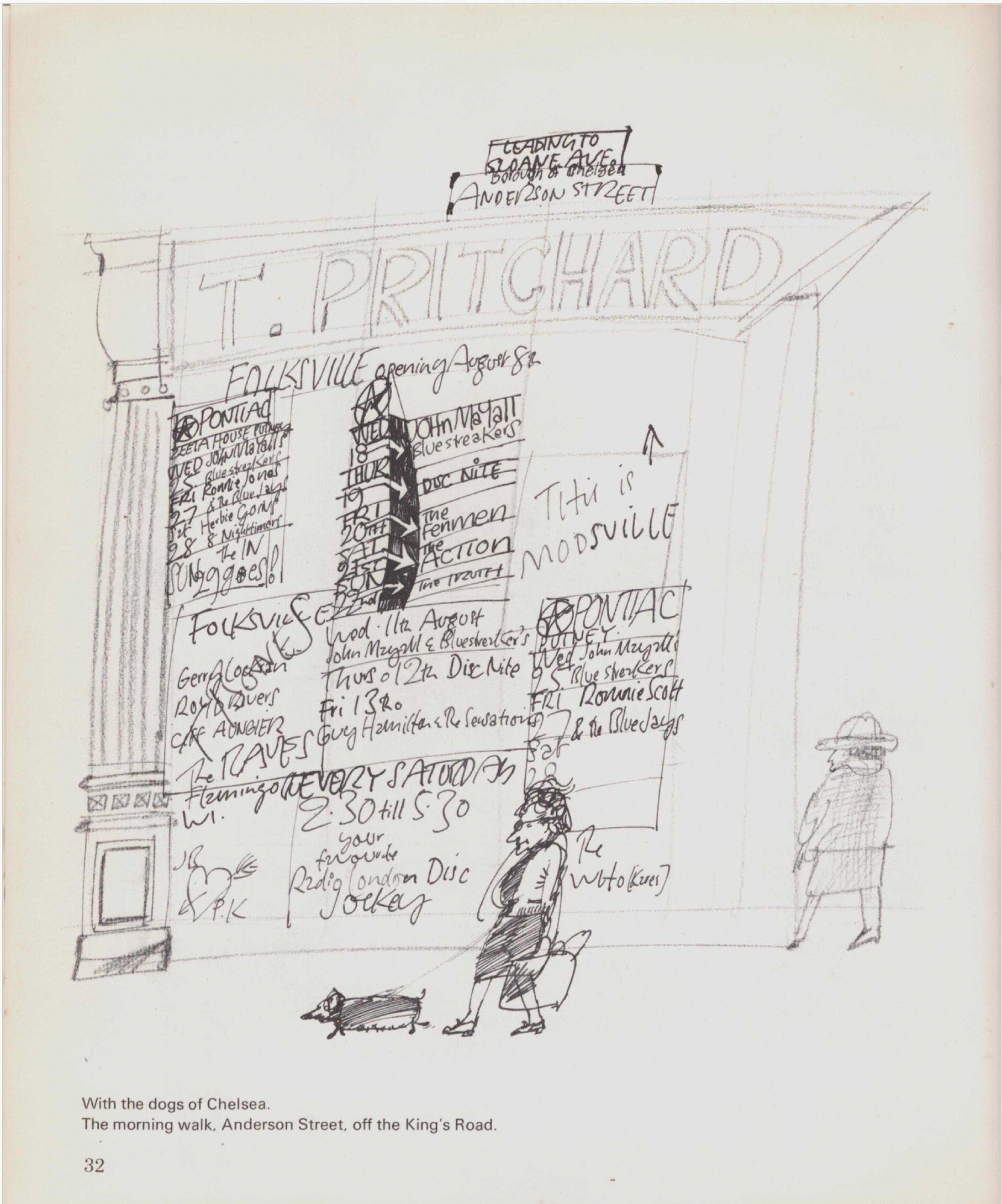
‘This Is Modsville’ . . .Pontiac billboards plastered over a shop front . . . From Paul Hogarth and Malcolm Muggeridge, London a al Mode (1966)

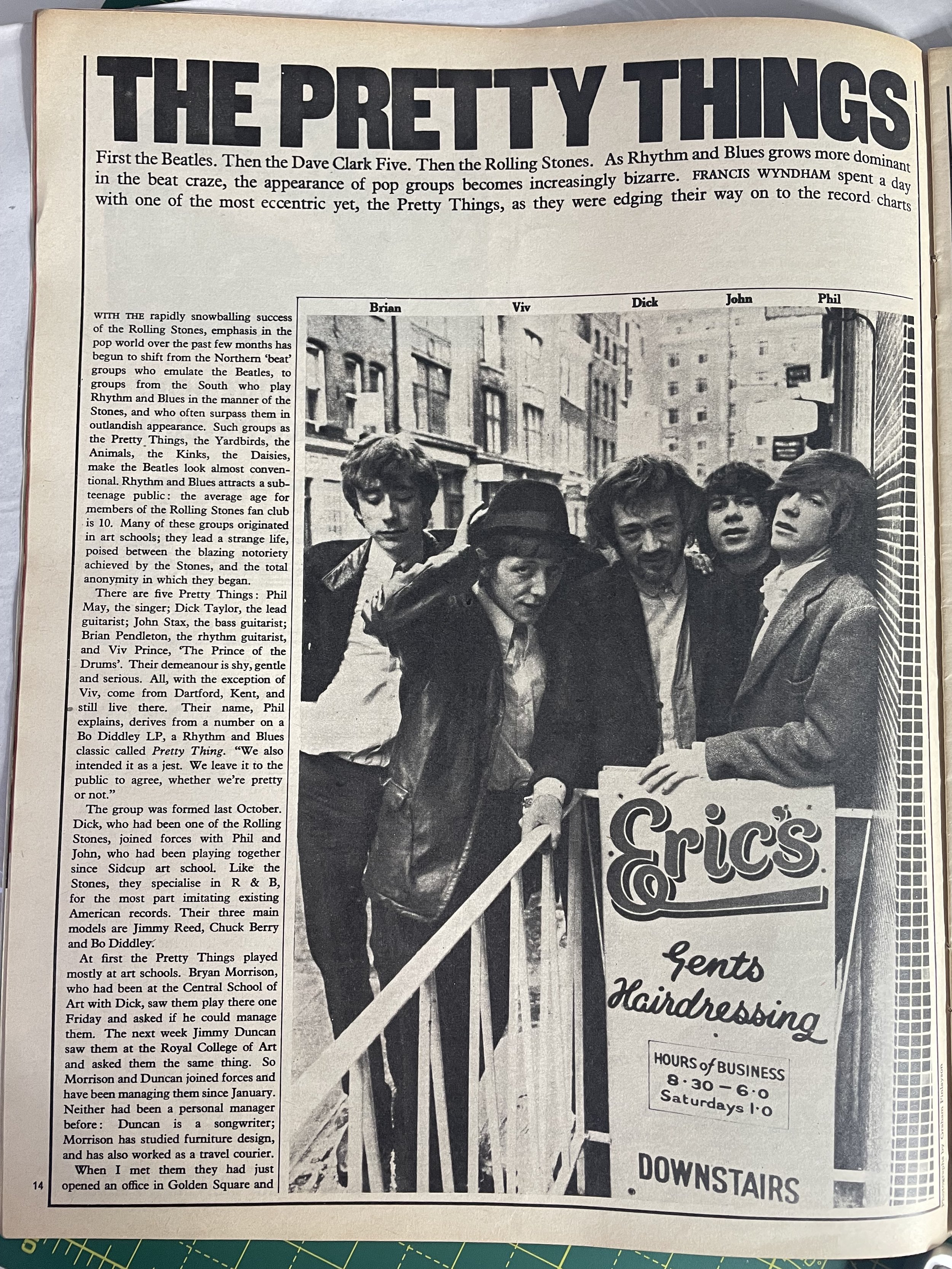
"The Long-Hair Musicians" – Sunday Times Magazine and The Pretty Things (July 1964).

Mick Jagger, John Lennon, Dave Clark . . . . and Phil May

July 12 1964 edition of The Sunday Times Magazine with a commissioned Pop Art cover from the very hip Peter Phillips

Ladies and Gentlemen . . . and all ten year-olds . . . The Pretty Things on the cusp of ‘blazing notoriety’ like the Stones or ‘total anonymity’ like The Daisies . . .

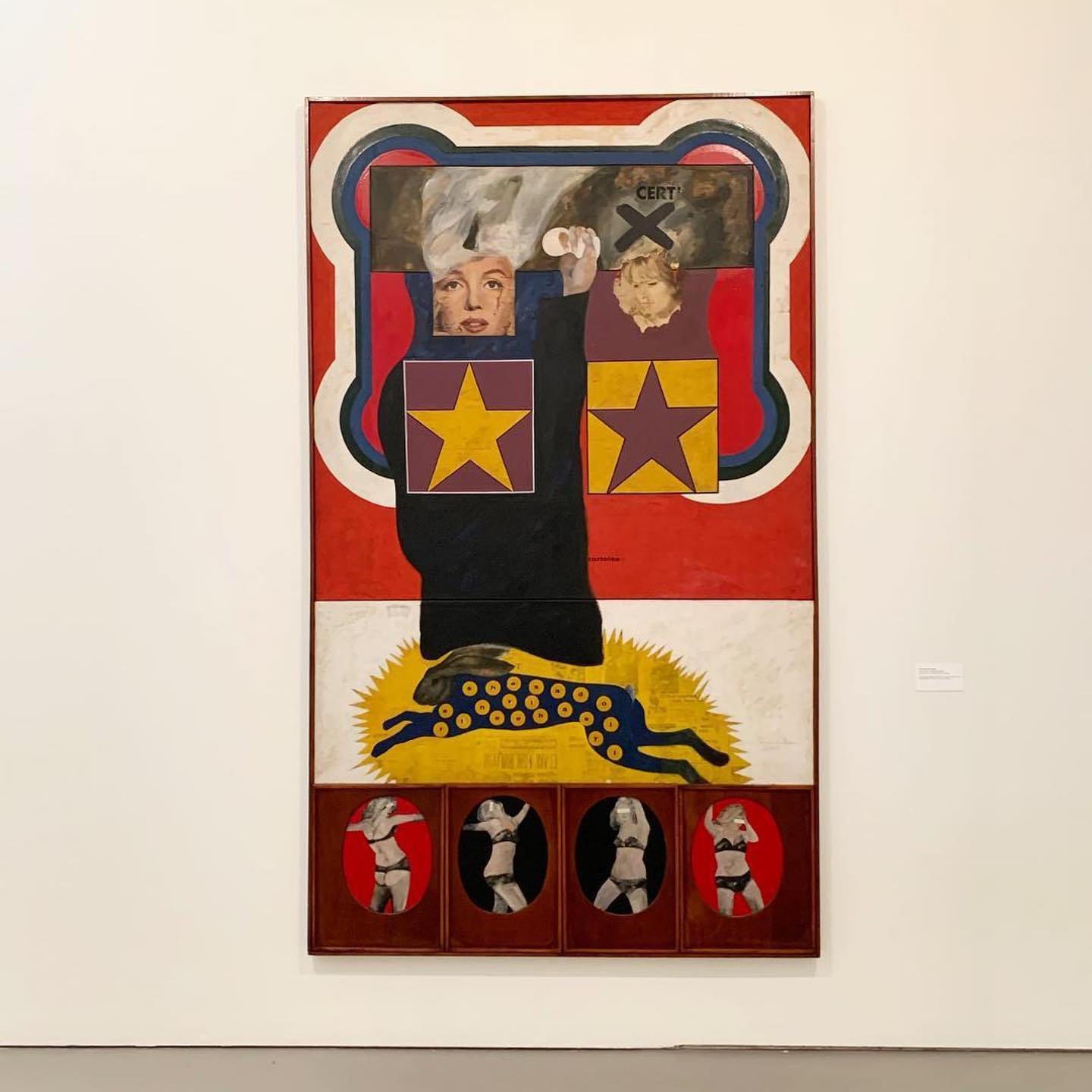
Peter Phillips, ‘For Men Only Starring MM and BB’ 1961

Peter Phillips ‘Entertainment Machine’ 1961

Peter Phillips, ‘Custom Print No.1’ 1965

The Commuters + The Cannibals: A Night Out at the Dublin Castle, Camden (1979)

All photographs by Mark Morreau – shot on May 16, 1979. Please don’t copy without permission, but if you do steal ‘em make sure Mark gets proper credit for his work. Thanks then to Mark and to Adam Blake

The Commuters came from Hemel Hempstead, hence the name . . . In their short lifetime they often supported the likes of The Cannibals, Lew Lewis, The Stukas and The Inmates. They played a million gigs with Watford’s The Bears and once upon a time supported the Clash in Bournemouth on their 16 Tons tour. They even played three successive night at the Gibus Club in Paris. Their moment of crowning glory was to headline at the Hope and Anchor and then break up.

Len Watkins sang, Peter Stanfield blew some mouth harp, Tim Brockett, played guitar, Luigi DiCasti plonked the bass and Greg Brimson beat on the traps.

The Legendary Cannibals on this occassion were Mike Spenser, vocals, Adam Blake, guitar, Johnnie Walker, guitar, Clive Leach, bass, Sion Evans, drums.

Both bands broke all speed limits

This page is dedicated to our friend Tim Brockett RIP

Outside of a killer three track single and a cut on a Garage Goodies album, The Commuters lasting claim on fame was as a sticker left above the stage at the Dublin Castle and then immortalised in Madness’ ‘My Girl’ video

THE WHO – LONDON 1965

The Who London 1965 . . . Ealing Club, Feburary 1965 with Fery Agasi (pinched from HERE)

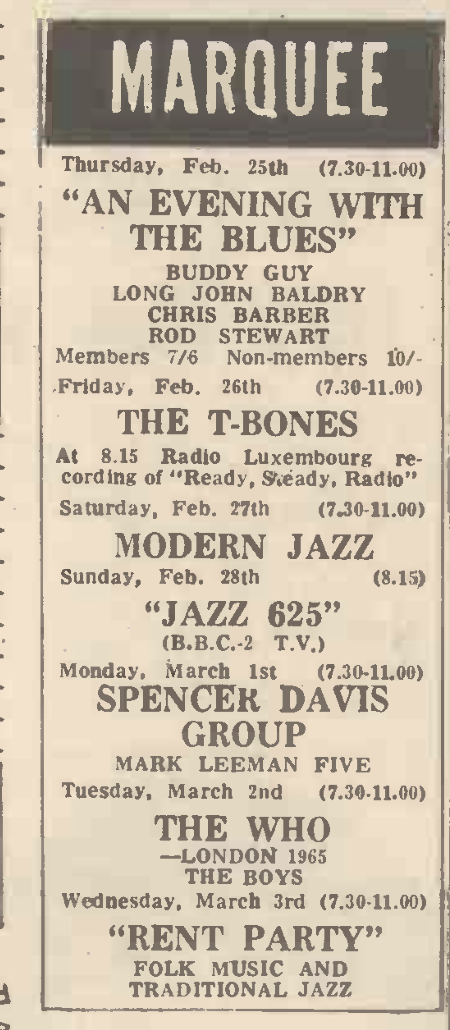
The Who – Maximum R&B Tuesday Nights at the Marquee . . . a 23 week residency that became a cornerstone of the band’s foundation myth. As much as anything we have the classic poster to thank for that impression, reinforced by the one in The Who Live at Leeds package. Yet, the majority of the residency at the Wardour Street club appears to have been advertised not in its maximalist rhythmic and bluesy incarnation but as ‘THE WHO – LONDON 1965’. Sometimes with the hyphen, sometimes not . . .

An original is on the left, above is the Live at Leeds repro

‘Maximum R&B’ was used from November through to December 1964. The Monday Red Lion and Wednesday Florida gigs were in the same week the block ad, below, appeared in Melody Maker

Following the Kit Lambert and Chris Stamp takeover there was obviously an on-going debate over the band’s name or rather how best to present it. The first show of the residency, November 24, they were billed a ‘THE “WHO”’ which seems to have been the case until January 5 when the quotation marks were dropped, though they were back on the 12th and stayed in place until the first gig in February, when they went absent once more. From February 9 until April 6, if you paid to see The Who at the Marquee it was under the banner ‘THE WHO – LONDON 1965’. For the final couple of Tuesday gigs in April, the 27th being the last of the 23, they were simply ‘THE WHO’.

On the Brunswick label for ‘I Can’t Explain’, and in press advertisements and posters promoting the single, there was never any uncertainty over the name, they were just ‘The Who’. The heavily used appendage ‘LONDON 1965’ for the Marquee (and Ealing Club dates in February) was then a statement and a declaration. It was a contract with their audience that laid down the claim that they were not only at the very centre of things in Soho, but they were its centre – ‘right here, right now, we are what’s happening’, it said.

Melody Maker (March 20, 1965)

An April ‘65 interview with Kevin Swift, published in the May edition of Beat Instrumental, doesn’t refer to any of this directly, but it is there in plain sight – Stamp and Lambert ‘look upon them as the embodiment of London’s various characteristics’, Swift wrote:

It is quite a valid theory when you consider if for a moment. After all, their act contains an aggressiveness, humour, action and an overall indication of frustration.

London – The Who. The Who – London. Even the name is representative of the anonymity of the big city

Beat Instrumental (May 1965)

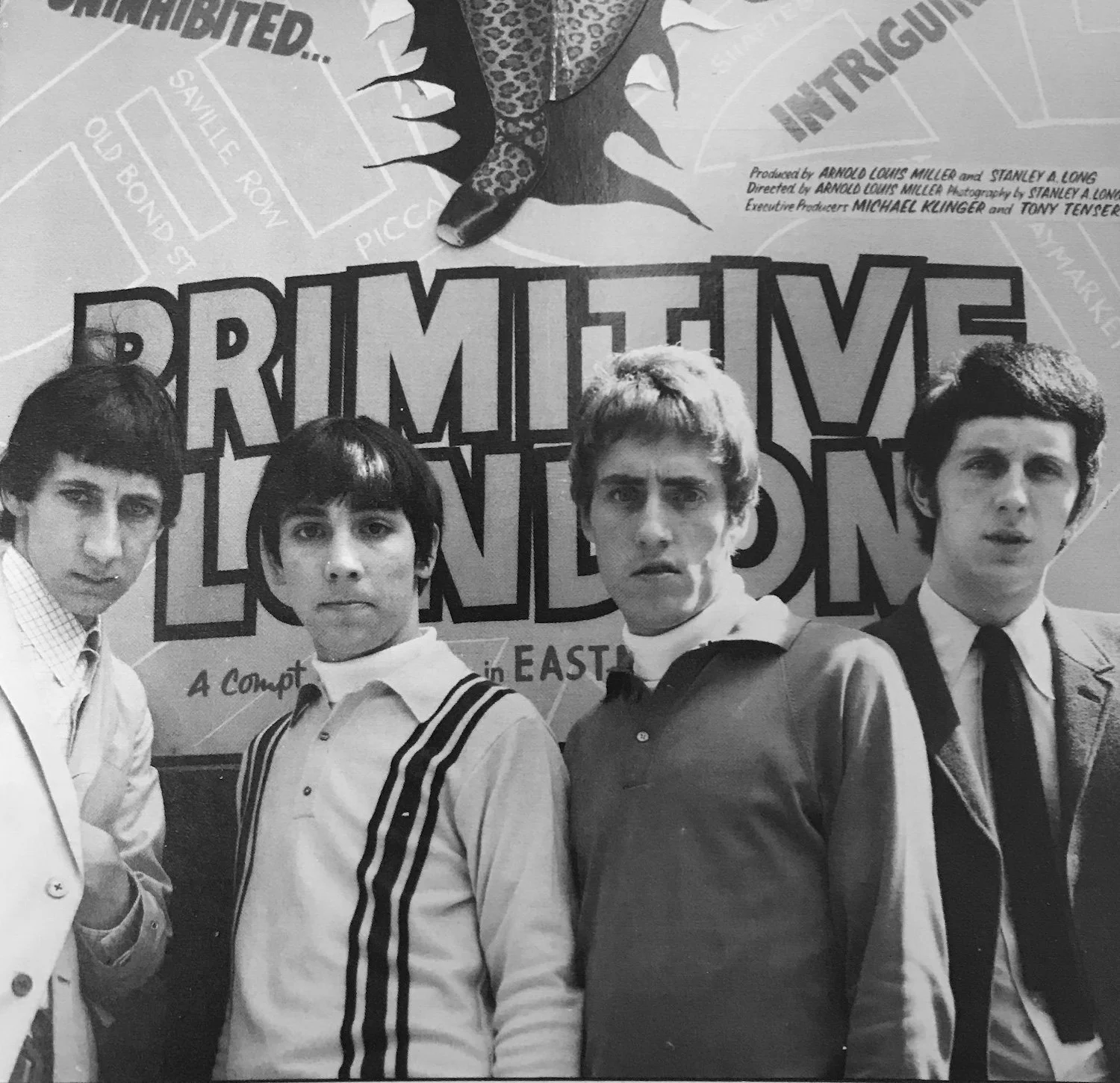
THE WHO – PRIMITIVE LONDON 1965

Record Mirror (December 19, 1964)

The High Numbers Record Mirror (July 23, 1964)

August 8, 1964

New Musical Express (April 23, 1965)

Before the Pop Art epiphony of ‘Anyway Anyhow Anywhere’, Townshend was already dumping the Mod tag: ‘this was a contrived artificial modness and we wanted to be ourselves’. Lambert’s reference to the band appearing in four films is intriguing. The French TV programme had been trailed in Britain as early as March in Record Mirror, with filming taking place at the Marquee, in Shepherd’s Bush and Hammersmith, Mods – Seize Millions de Jeunes (Sixteen Million Teenagers – tx March 18, you can find it on Vimeo as originally broadcast). Lambert is the ‘adult’ interlocutor, explaining teenage London. In one shot you see Moon (?) seemingly helping to design the Marquee poster but,The Who’s appearance aside, the highlight is the kids, smashed blocked and dancing like beautiful fools to some other band chopping away on Bo Diddley’s ‘Who Do You Love’.

One of the two British TV spots could be Ready Steady Go (tx January 29) and the promotional short for ‘I Can’t Explain’ shot by the two managers and sold to Rediffusion to be used in ‘That’s For Me’ (tx March 15). The film ‘about a stripper’ was Carousella. The reference to it in this NME piece confirming, for me at least, that the band and management had contracted/cleared their appearance with the documentary’s producers, Mithras Films. They were billed as “The Who”. . . Much, if not all, of this on the films is in Andy Neill and Matt Kent’s essential Anyway Anyhow Anywhere: The Complete Chronicle of The Who (2007)

Screengrab from Carousella

Mail Bag, Melody Maker (June 19, 1965)

It's Madness: Don't Say 'Fab' Say Mickey Finn and the Blue Men

I’ve been digging around in the pop music press of 1964, searchin’ for material on the R&B boom generally and The Yardbirds in particular. I was struck by how heavily the East End Mod group, Mickey Finn and the Blue Men were hyped, more adverts than even the Stones managed. The cartoon figures caught my eye as much as the pork pie hats

Blue Beat alongside Motown, Chicago blues, Stax and the jazz of Mose Allison and Jimmy McGriff was just part of the panoply of styles that R&B encompassed in 1964. Mickey Finn got in on the act by having their first record released on the premier UK-Jamacian label, getting a testimonial from the man himself, Prince Buster, and then pulling into the mix Bo Diddley and Chuck Berry.

I’m not that keen on the band’s neophyte ska moves but I love the R&B raver on the b-side of ‘Reelin and a Rockin’, ‘I Still Want You’. Lovers of the freakbeat sound go for their 1967 release ‘Garden of My Mind’. Munster Records have pulled together all the band’s recordings from 1964–67 with top sleeve notes from Mike Stax (Ugly Things), you can hear their latest by dialing the number GER 7080 /7089. . .

Mickey Finn began the year as a five piece and ended it with six members having dropped the mod look and taken up posing on building sites and railway platforms as if they were the Stones or Pretty Things.

The added member, at least in publicity shots, was Jimmy Page – session man and harmonica player on the early singles.

Peter Aldersley review in Pop Weekly (February 16, 1964)

NME (July 3 1964). Derek Johnson also reviewed the High Numbers single which he described as ‘compelling styling but weakish material’.

Pop Weekly (July 18, 1964)

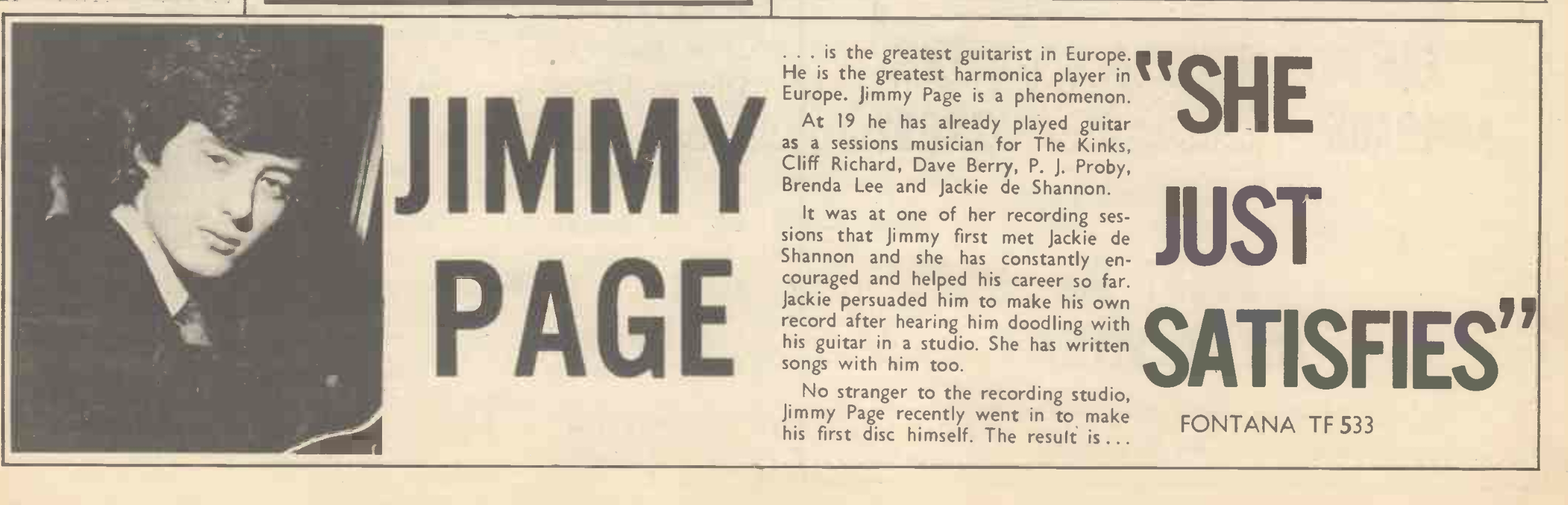
A Little less than a year after moonlighting with Mickey Finn our man is declared ‘the greatest guitarist in Europe. The greatest harmonica play in Europe. Jimmy Page is a phenomenon’. Why stop with Europe, why not the world?

Record Mirror (February 20, 1965)

Pay for an advert and get one of Record Mirror’s special reviews. Who said payola was dead . . .

Record Mirror (February 20, 1965)

Beat Instrumental (August, 1965)

Part of a set of profiles on the faces behind the hits, Sunday Times (February 20, 1966)

What's In A Name? Them Who Are Dissatisfied . . .

Looking for some context to place Mick Farren’s Social Deviants in Pin-Ups 1972, I took a sideways glance at how groups named themselves in the early to mid-1960s. Top of my short list of group names was Them. The pop correspondent of The Belfast Telegraph neatly captured the truculent provovation the band no doubt intended by adopting the pronoun:

He drew grimly on a cigarette and said: “We’re not wanted here. If you don’t belong nobody wants to know you”. He is, in fact, one of Them.

One of them in more ways than one – Billy Harrison.

One of “Them” – that quaintly named Belfast rhythm and blues group which sailed off this week for England – for good.

And one of them – those who find that society is not yet conditioned to really accept them.

For them are a five-strong outfit resembling the Rolling Stones with hair that must be longest in Ireland

Belfast Telegraph (June 12, 1965)

Disc Weekly (February 26, 1965)

From Pin-Ups 1972:

In any revised edition ‘The Dissatisfied’ will be slotted in between The Others and The Measles:

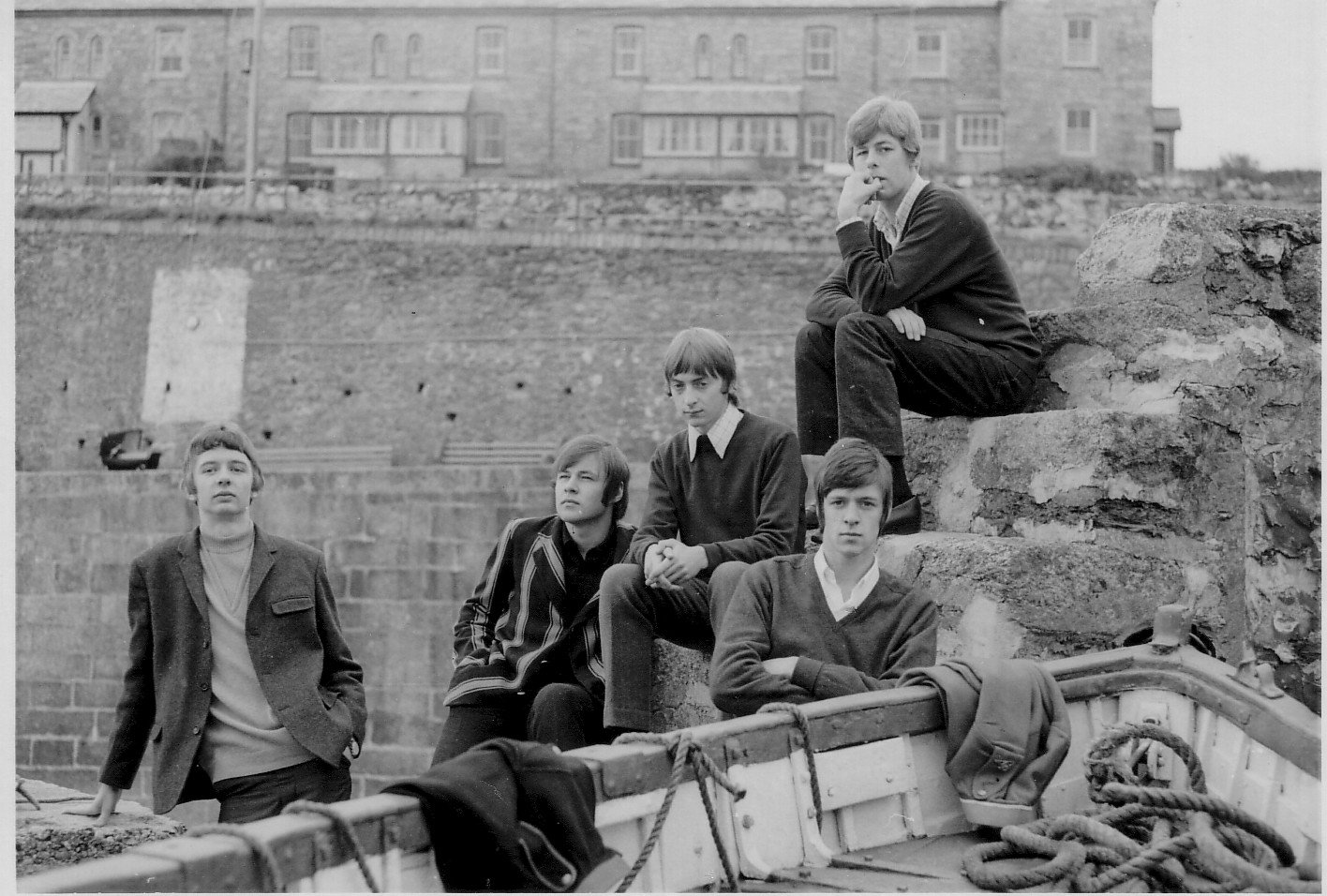
Despite playing with such esteemed Marquee headliners, and getting a stamp of approval from ‘Birds man Chris Dreja, I’d never heard of The Dissatisfied. Turns out there was a very smart looking bunch of likely lads from St. Austell (great band bio HERE) but they formed a year after this Dissatisfied, who I reckon were otherwise known by the much less truculent name The Dissatisfied Blues Band helmed by guitarist Jim Cregan who went on to play with Blossom Toes, Cockney Rebel and Rod Stewart [HERE].

The Dissatisfieds supporting The Yardbirds )ctober 31 1964

nicked from kernowbeat.co.uk . . . forever The Dissatisfied . . .

From the same issue of the Belfast Telegraph (September 26, 1964) in which Them appeared Maureen Cleave gave her opinion of the Bo Street Runners: ‘ugly but memorable’ which in this context seems fair . . .

The Who Rave On With Alan Freeman (February 1966)

This late 1965 interview with Alan Freeman, published in the February 1966 edition of Rave, is the best contemporary summation of the breakneck speed of change in pop that the band were now pushing. The shift away from Mod and then Pop Art is discussed: ‘We found out Mods were just as conformist and reactionary as anyone else’ . . . ‘So far as The Who are concerned, the pop art image that stunned listeners last summer with things like “Anyway, Anyhow, Anywhere” is already a dead carcass’ . . . staying ahead of the pack was the only consistent philosophy, innovation and renewal – ‘searching endlessly for newer musical forms that would reflect nobody’s ideas but their own’.

Townshend reiterates the importance of creative violence in the band’s acts of reinvention, comparing what they do to the everyday violence of bar-room fights, dance hall punch ups and war in Vietnam – all ignored by the man in the street. But ‘immediately a bit of property is smashed up he goes potty and cries out about senseless destruction’.

‘I reckon it’s this unfortunate national knack of putting higher value on things than on people that has made The Who the most unpopular group in pop’, wrote Freeman. And, as if to echo Kit Lambert’s claim that the band were involved in a ‘new form of crime’, one that attacked bourgeois propriety, he noted that the band were now starting to attract ‘quite a few gamblers and reformed villains who turn up at various parties and first nights. And I’ve heard some of them raving about the Who’s records’.

Townshend digs deeper into the art influences on his auto-destruction, including Metzger’s idea for ‘putting up statues with weak foundations so that they’d all fall down inside a year’, which was new to me. All this emphasis on violence and aggression was clearly understood to be the prelude that logically ends in the group’s own demise; its self-destruction: ‘It doesn’t matter in the long run. Eventually we’re going to destroy ourselves as a group. It has to happen sometime’.

Enjoy!

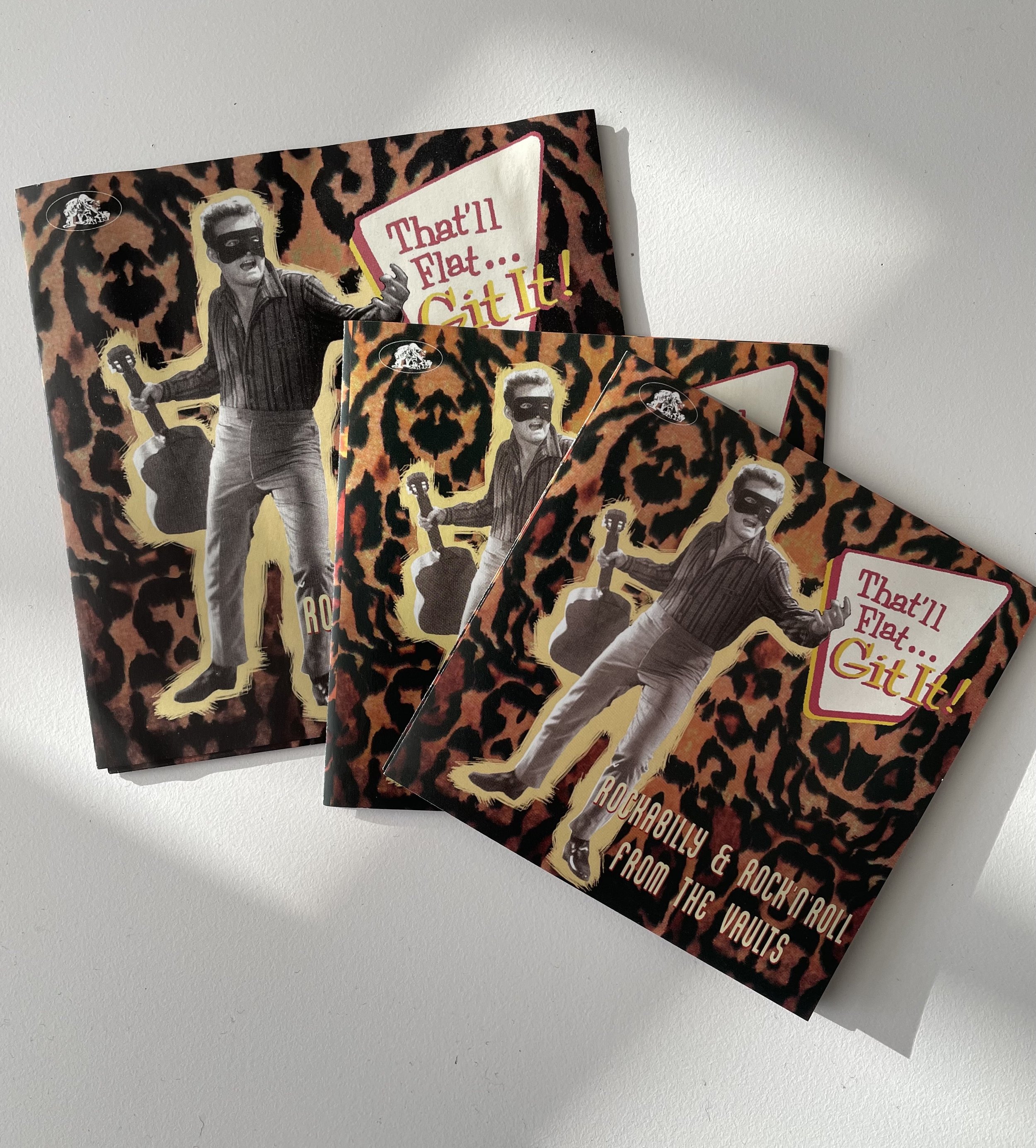
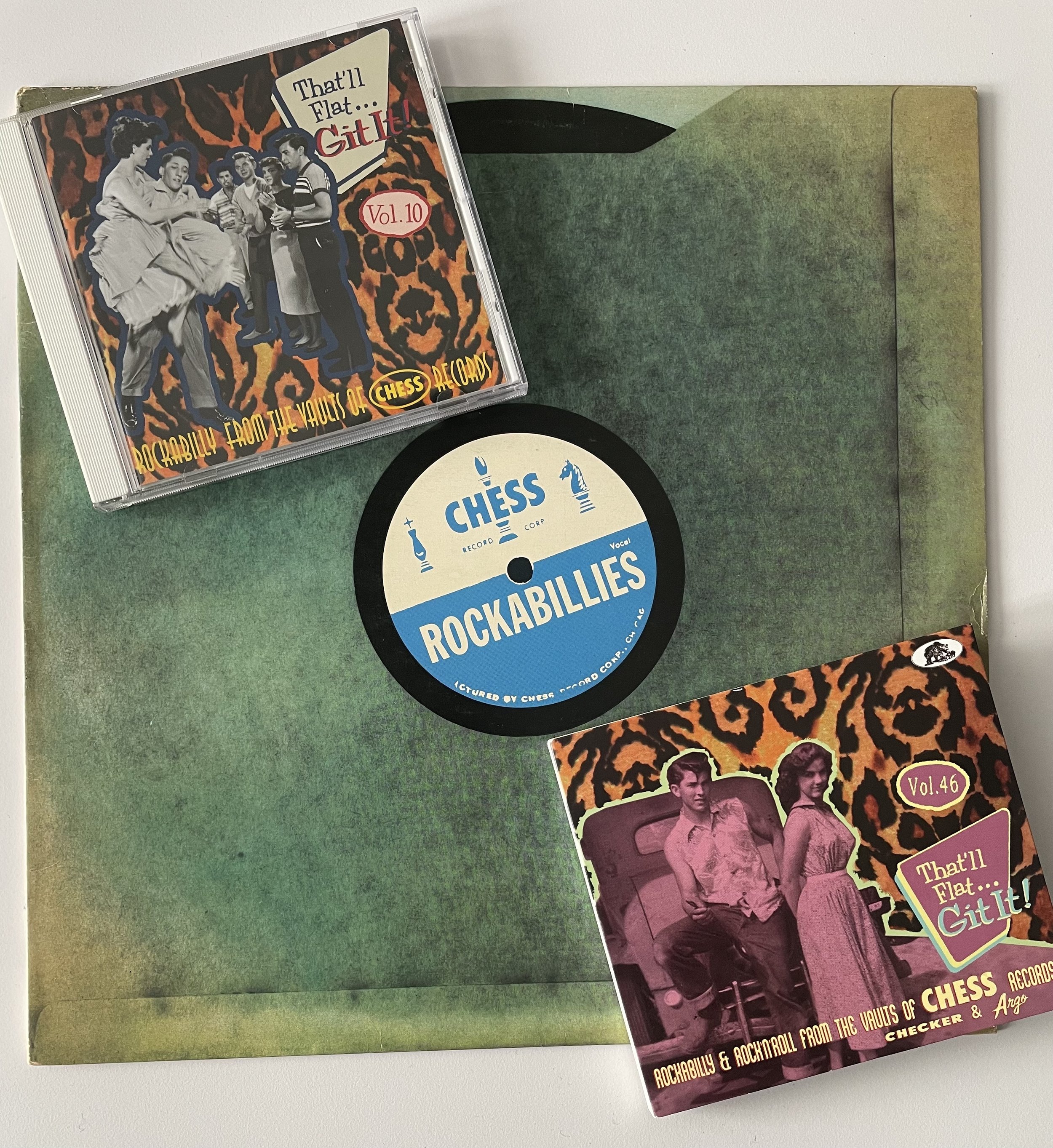
Your Move . . .That'll Flat. . . Git It! Volume 46

Bear Family have just issued volume 46 in their rockabilly series That’ll Flat . . . Git It! that began waybackwhen in 1992. I don’t pretend to listen to each new volume with the same ardent fervour as I did thirty years ago, but my admiration for the compilers’ dedication to the task of cataloguing and archiving this small corner of popular music knows no bounds. . . I’d buy each release for the photos and sleeve notes alone. Whenever the task is done, if that is ever likely or even possible, I hope they put all the text and images together in one giant hardback book

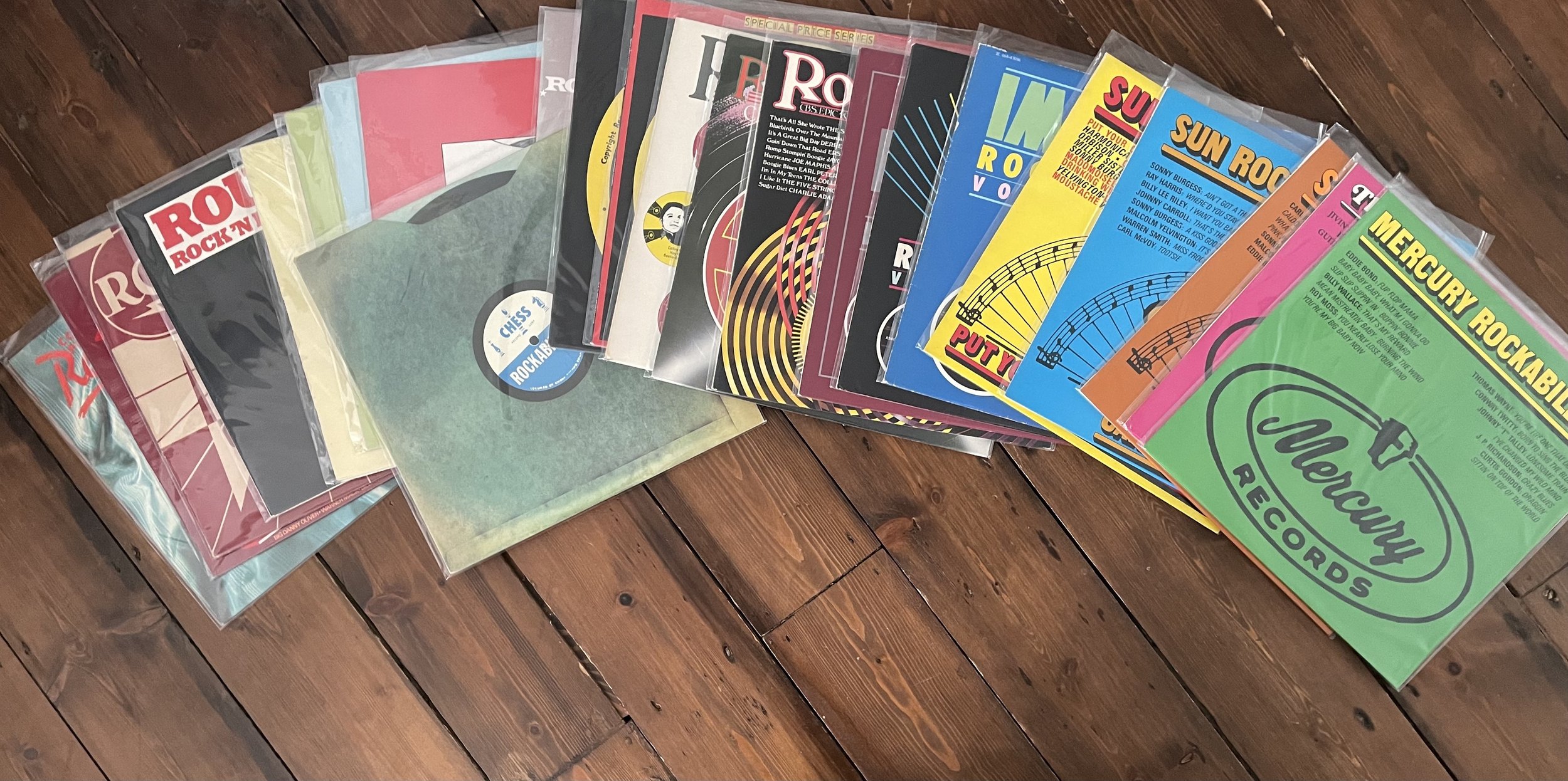
The series is the digital version of the rockabilly by label compilations that were released from the mid 1970s to early 1980s that were curated by Rob Finnis, Bill Millar, Colin Escott, Stuart Colman and the like. It was then a very British obsession. Some 20 plus albums were released, which apart from the then ongoing excavations in the Sun vaults must have seemed pretty exhaustive. Yet, here go Bear Family barrelling on with near 50 silver discs in their catalogue.

Volume 46 is dedicated to Chess and affliate releases, it is the second one to feature the label. 64 tracks in all. In their notes for the original vinyl release Finnis and Millar considered its 20 tracks to be ‘virtually the sum total of the Chess brothers erratic forays into rockabilly’. Perhaps their view of the form was stricter than those who came after, certainly Bear Family, with volume 27, expanded their scope by adding “rock ‘n’ roll” to ‘rockabilly from the vaults’ which meant they could include Chuck Berry and Big Al Downing on their latest release. That’s no hardship to endure (and better than some of the more uptempo country numbers that have helped swell out the track listing in other volumes in the set).

Anyway, this one on v.46 gets my stamp of approval. Tell us about your baby Steve . . .

Greased: two new reviews of 'Pin-Ups 1972'

Grant McPhee reviews Pin-ups 1972: Third Generation Rock ‘n’ Roll for Into Creative

This publication takes a similar format to Jon Savage’s ‘1966’ to posit the claim that 1972 is another important milestone in ‘the story’ of music. It’s a well-argued point that focusses on 1972 being when Rock ‘n’ Roll went back to its roots, in order to reclaim itself from the patchouli self-indulgence that it had sadly fallen into. Other writers have made a claim for 74/75 being when Rock and Roll went back to basics, but this makes a convincing case that 1972 was where it began. Rather than starting with Dr Feelgood or New York Dolls, we have Bowie and Bolan, Iggy and Lou, Roxy, The Who’s Quadrophenia and most refreshingly, Mick Farren, an unsung hero and huge influence on the soon to emerge Punk sound.

The level of research is quite astounding; I know that Peter meticulously went through hundreds of period magazines, NMEs, Melody Makers, Newspapers, Fanzines and more to ensure historical accuracy, rather than falling into the trap of repeating oft-heard myths. This trawl through culture really pays off as it gives a tremendous sense of period for the reader and envelopes you completely in the world of the greaser as the story emerges.

review published HERE

Simon Wright reviews A Band With Built-In Hate and Pin-Ups 1972 for Only Rock ‘n’ Roll London

Two books from Peter Stanfield which follow the same approach, developing a hypothesis by the careful selection and presentation of quotes from a wide variety of other sources. This means that he will never be one of my favourite writers – I prefer the highly-opinionated school of Nick Kent , Greil Marcus and Lester Bangs – but the material he chooses is for the most part relevant and stimulating and in some cases new to me, so that is enough to make for two entertaining and thought-provoking volumes.

Stanfield also shares two of my prejudices: that the early ‘70s were a brilliant time for music and that the Who peaked with Sell Out and Tommy. Pin-Ups 1972 follows in the steps of Jon Savage’s book on 1966 and David Hepworth’s review of 1971. Unlike these two titles Stanfield makes no attempt to review the contemporary music scene in its entirety but instead zeroes in on a tight and inter-related group of acts including Iggy and the Stooges, the New York Dolls, Lou Reed and Roxy Music, all firm favourites of mine. He notes how Marc Bolan had lead the way, and how Bowie was at the centre of it all. A surprising outlier is the opening chapter on Mick Farren, by then no longer a performer but a full-time writer and generally angry person. Stanfield gives a clear account of tectonic plates shifting within the London music scene and how this helped rock’n’roll shake off the last fringes of the 60’s as these groups evolved a Third Generation Rock’n’Roll, the subtitle of the book.  He is also good on how the seismic eruptions of 1977 started as minor tremors five years previously.

A Band With Built-In Hate is a fine book about the Who that would be better served by its sub-title The Who From Pop Art To Punk. Stanfield spends little time on the implications of the Townshend quote beyond noting that the members of the Who were four very different individuals who did not get on, hardly new news. Much more interesting is what Stanfield has to say about the relationship between the Who and popular culture in general and Pop Art in particular. Stanfield is helped greatly by extensively quoting Nik Cohn, still the most pithy and interesting commentator on the Who in the 60’s. The final chapter is enlivened by a wonderful rejection letter from Townshend to Eddie And The Hot Rods’ record company where he refers to his “meditative Mercedes buying” – truly the Godfather meeting The Punks. As with pin-ups 1972 the book concludes with the influence of the Who on punk, and vice versa.

Academic in tone but accessible in content these two books are recommended to bored teenagers of all ages.

Review published HERE

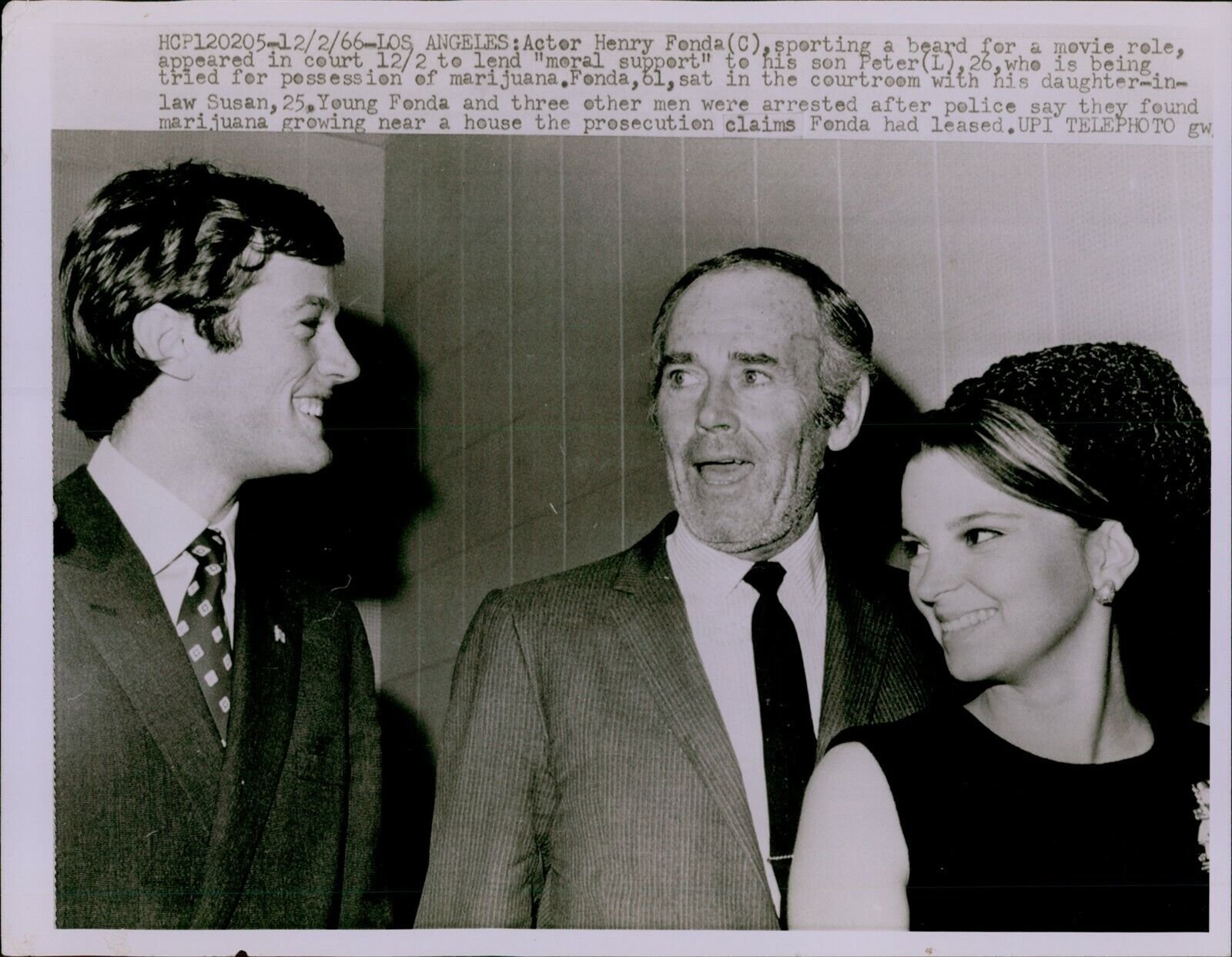
A Hard Day's Night on The Strip and in the Courts With Peter Fonda

Somewhere in that period between The Wild Angels and Easy Rider, when Peter Fonda was busily trying to reinvent himself as a counter-culture outlaw and deflect attention away from his privileged upbringing, his fantasy and real worlds converged.

In 1966 he had two run-ins with the law, one was easily resolved the other went right to the edge.

***

Fonda spent a good part of the 1960s dismissing his more famous father and sister even as he chased their coattails. He’d appeared in light romantic comedies on Broadway, in the teenpic Tammy Takes Over and been promoted by Hollywood columnist Hedda Hopper as the ‘new face’ of 1962. He didn’t need to take on such shallow, inconsequential roles, he had the inheritance left by his mother (she’d committed suicide when he was only ten) on which he could live comfortably. Maybe he just lacked in imagination, but family and such insubstantial employment did give him something tangible to kick against.

The year before reality came knocking, he took acid with The Beatles and The Byrds – a rehearsal for his role as an explorer of lysergic infused mind-expansion in Corman’s 1967 fantasy The Trip. His time spent with musicians also had an influence on his bid to become a pop star, cutting a folk-rock single in 1966 with Hugh Masekela as his producer. One side of the 45 was a cover of Donovan’s ‘Catch the Wind’, on the other was an original composition by then unknown Gram Parsons, ‘November Nights’. Not having much of a singing voice didn’t help Fonda’s hip aspirations and his side-line as a pop singer floundered. He did, however, repay his debt to Parsons by securing a cameo for The International Submarine Band in The Trip. Never the hipster, Corman overdubbed Parsons with the Electric Flag who would feature on the film’s soundtrack album (why pay for more than was contracted?). [HERE]

Having played an outlaw biker, Fonda positioned himself as part of the counter-culture and took his camera onto the streets of Hollywood to capture the nation’s youth in revolt. He was 26 years-old but clearly thought to be a threat to the city’s good citizens and was summarily arrested.

The fracas was a teenage riot which mainly took place on weekends. Discontent had been festering for over a year as businessmen, who wanted to develop Sunset Strip, met head-on with white middle-class teenagers who just wanted to have fun. The police enforced curfew on teenagers finally got out of hand on a Saturday in November 1966. (Events anticipating by over a decade The Clash’s ‘White Riot’ and The Mekons’ ascerbic response: ‘Never Been In A Riot’).

The riots didn’t amount to much but they served as notice and symbol of a generational divide grown exponentially since the previous decade’s moral panics about juvenile delinquency.

Out racing Corman, Sam Katzman was quick to exploit the headlines and teen drama of it all with Riot On Sunset Strip, released by AIP in March 1967. As with the company’s earlier JD movies it was the parents who were to blame . . . It was broken homes that made drug abusers out of nice suburban kids. Viewers got to watch the Chocolate Watchband do great impersonations of the Stones and the Yardbirds, hifi freaks got the best soundtrack album of the era and the rest of us got to see Mimsi Farmer freak-out after some lousy rich boy spiked her drink with LSD.

Peter Fonda being arrested, right of picture

The story even made it to the pages of the British weekly pop press, ex-Beatle publicist Derek Taylor, now working for The Byrds, sent back this report for his regular column in Disc and Music Echo (June 4, 1966)

Fonda successfully argued that he was not a rioter but was on the Strip to document events for a film he was making. Getting out of his other bust that year was not so easy.

During post-production on The Wild Angels, Fonda and three others were charged with possession of marijuana though, as it later became clear, this was not for holding a few sticks of weed but, in Fonda’s case, for being the moneyman behind a dope farm. The court case got underway in December 1966, The trial finished before the end of the month with the jury split and the case against Fonda dismissed when a key witness failed to appear (the suggestion in news reports was that she’d been paid off). The judge left Fonda in little doubt that he considered him to be guilty as charged. When the story had first been reported, it seemed only a few plants had been found in a house in Tarzana that Fonda was said to have rented but which he claimed only to have visited to meet with friends. In fact, ‘large quantities of marijuana were found all over the house’, the judged admonished Fonda, ‘and it is inconceivable that you were unaware of its presence in view of your repeated and prolonged visits there.’

For this rebel, having his father testify on his behalf must have rankled and he spent much effort in subsequent press interviews explaining he no longer smoked or drank anything, Easy Rider soon suggested otherwise.

UPI wire photo December 2, 1966

All the above is a sidebar to a chapter on Fonda’s The Hired Hand for my next book, out sometime in 2023.

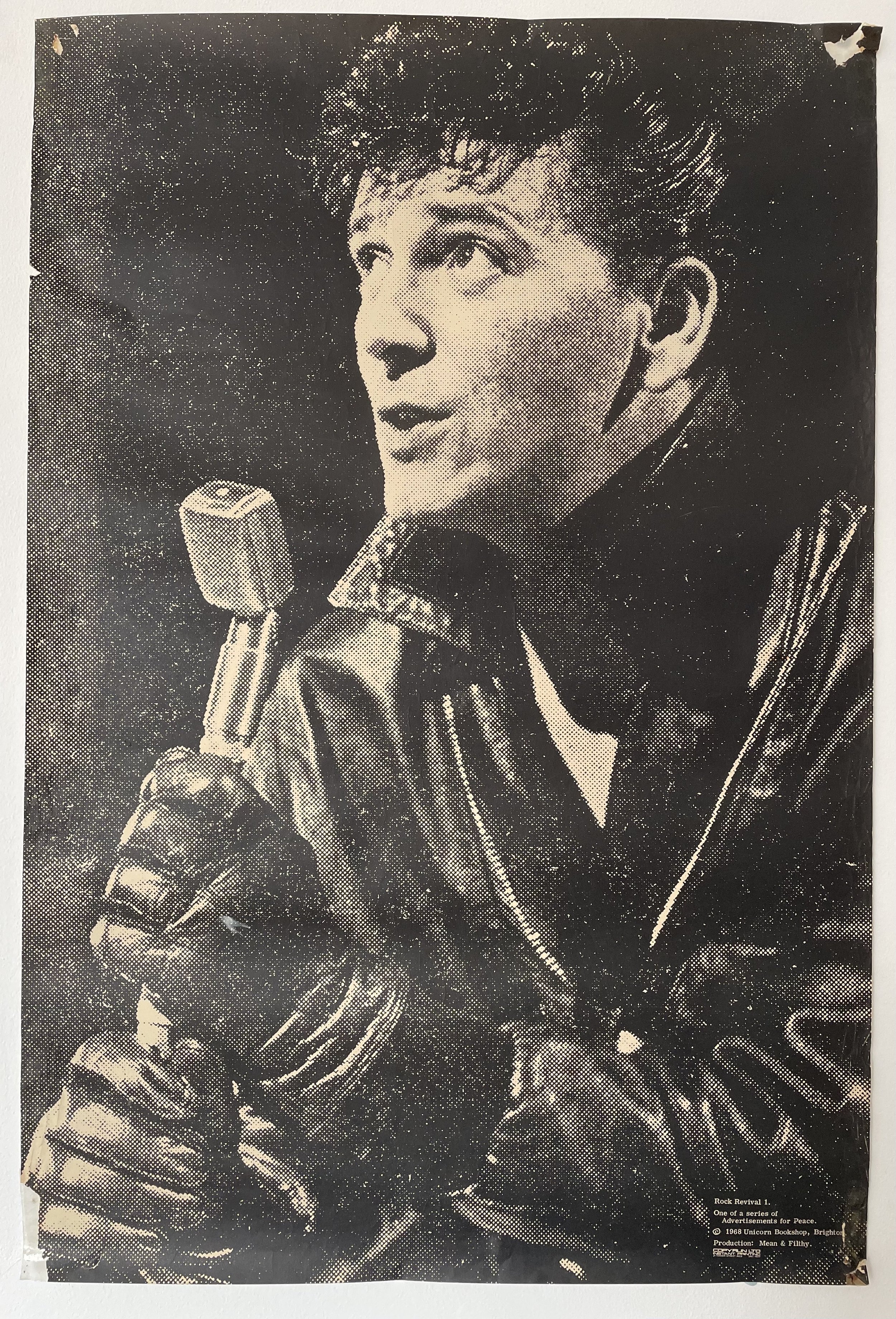
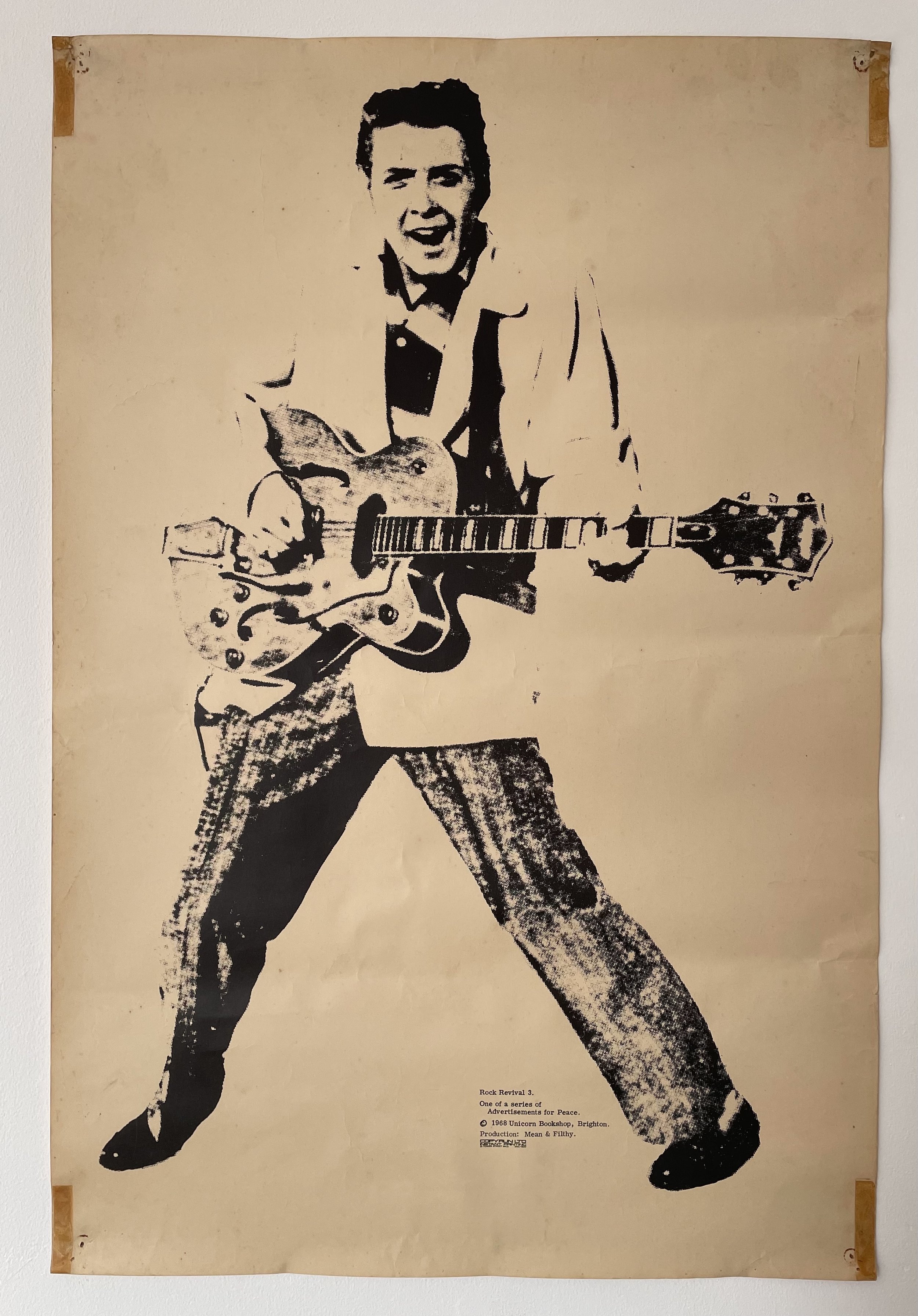
Rock Revival, Brighton 1968: Advertisements for Peace

1968 and the rock ‘n’ revival as pursued by The Who was in full-flight with ‘Shaking All Over’ and three Eddie Cochran covers added to their set, while The Move, having put ‘Weekend’ on their debut album, issued another Cochran song on their live EP ‘Something Else’. Mick Farren and his pals kept the flame burning bright in the underground press and with his Deviants kept the faith. He also teamed up with Brighton’s Unicorn Bookshop for a run of posters sold under the tag ‘advertisements for peace’ . . . and there was nary a Teddy Boy in sight among these rock history mavens.

Numbers 1–3 are part of a long-ago acquired batch of posters bought by Vinyl Head, Ramsgate. Each is 30 x 20 inches, published in 1968 by Unicorn Bookshop, Brighton with ‘Production: by Mean & Filthy’.

Unicorn Bookshop was situated at 50 Gloucester Road. It was opened by American Bill Butler and ran circa 1966–1974. Its psychedelic–beat–counterculture goods were advertised by a mural that covererd both sides of the shop front and which has recently been restored to its original glory.

There are a number of blog posts on the shop, John May’s site has one of the more detailed accounts [HERE] and there is also a Butler biography by Terry Adams, which gives some background on the selling and distribution of the posters, but there’s little to be found on their design.

Mean & Filthy was a front put together by Mick Farren and Steve Sparkes – Rich Deakin’s Keep It Together has the lowdown on their activities. A revised version of #2 for a Roundhouse gig (with Deviants 3rd on the bill) is reproduced, along with a Dylan, also a Mean and Filthy production, in Mick Farren’s Get On Down history of the rock poster. Based on a cover for Oz, the Dylan was a big seller, designed by Vytas Serelis, artist, sitar player and friend of Marc Bolan.

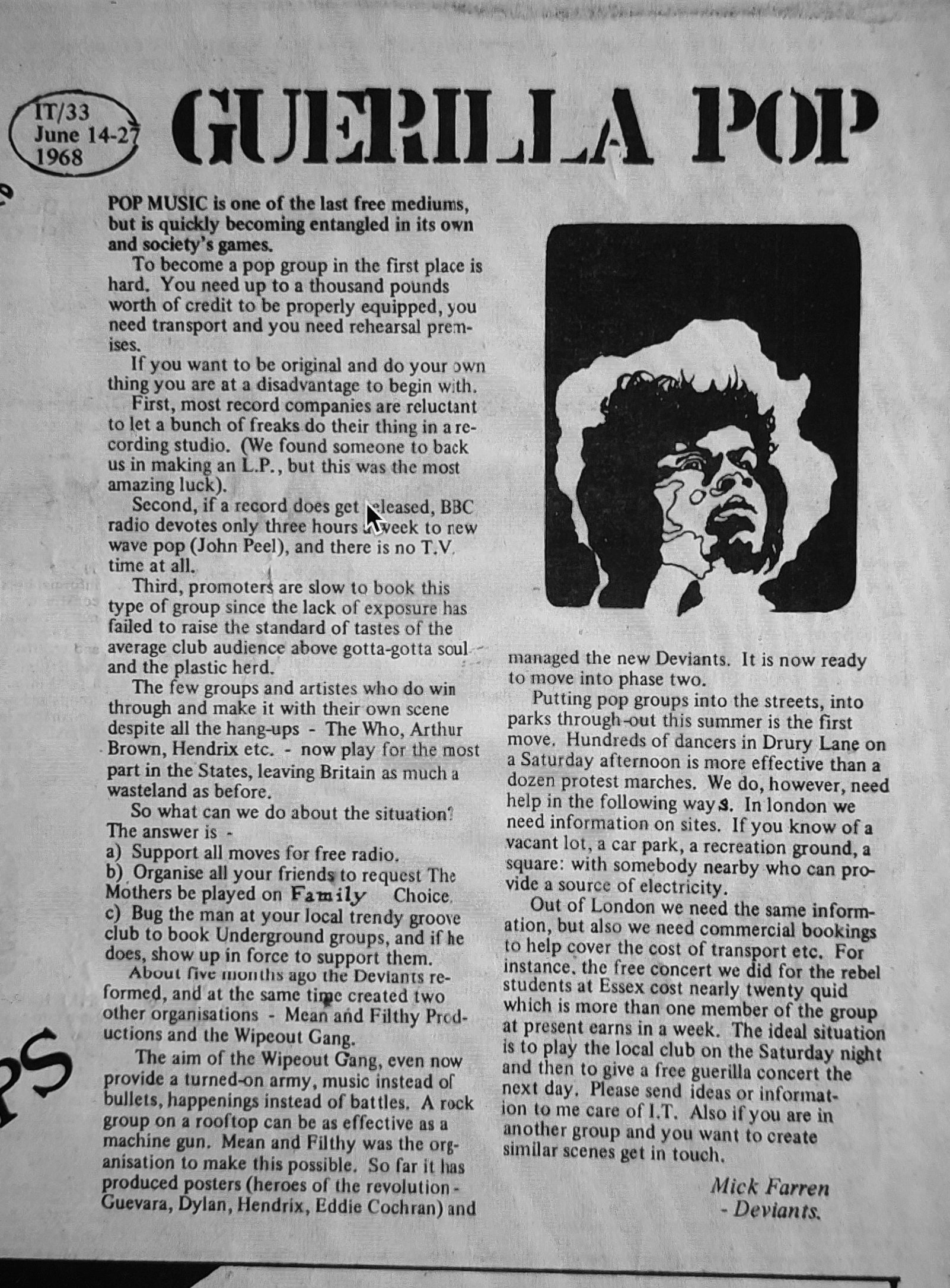
As Deakin points out, Farren had laid out the thinking behind the series in a piece for IT. . .

Guevara, Dylan, Hendrix and Eddie Cochran – heroes of the revolution

Paul Kaczmarek, who worked with Bill Butler, has very kindly provided the following information about the various rock related posters the shop printed and sold.

There were only three titles directly related to the ‘Rock Revival’ series:

Rock Revival 1 - Gene Vincent  (2,622 printed)

Rock Revival 2 – Elvis Presley (2,565 printed)

Rock Revival 3 – Eddie Cochran (2,500 printed)

These three, along with the Dylan and Hendrix, were the only Mean and Filthy productions – all first published March 1968. There are three variants of the Dylan poster (black/grey, orange and green versions). They were heavily reprinted in the early 1970s with some 10,000 in distribution. The numbering system used related to the sequence of release and was not a continuation of the Rock Revival series, so Jimi Hendrix was Unicorn’s 14th poster (with two variants), it was also based on a Vytas Serelis illustration. Other posters that are of interest include:

#8 – ‘Beatles scene’ (drawing by Richard O’Mahoney)

#36 – Paul McCartney (PK has found references to this but has not seen a copy).

#37 – John Mayall

B1 – Maharishi and The Beatles (drawing)

C1 – Eric Clapton (PK has not seen a copy only references to it in sales invoices)

The three Rock Revival posters link effortlessly with Farren and Barker’s Watch Out Kids and with the aesthetic of Ian Sippen and Peter Shertser’s Union Pacific label [HERE] . . . This was greaser rock ‘n’ roll for the new generation and Mean and Filthy had their bedroom walls covered.

My thanks to Phyll Smith, Don Lickley, Paul Kaczmarek and @heaven_mirror for feeding me with material and insights. Paul’s book, Poetry, Publishing and Prosecutions – Bill Butler and Unicorn Bookshop is due to be published in 2023

Nik Cohn – Lost and Found: 'Mad Mister Mo'

Nik Cohn has published only a handful of short stories, ‘Mad Mister Mo’ from the October 1966 edition of King magazine is therefore something of a curiosity piece .

Given that his father was a celebrated history professor I guess you could chance a Freudian reading of this story of Mad Mo the history teacher: ‘He smelled of chalk all over and wore a ragged black gown with holes in it. When he walked, he gathered his black gown in tight around him like a shroud’. He is a monstrous figure who ‘threw out his arms like a mad messiah and he preached me lust and thieving and blashemy. He shouted at me and he said that religion was bad and murder good, love was bad and hate was right’. He preached me the triumphant victories of evil’.

Mo is certainly mad, but is he a tyrant, drunken fool or phantom figure of a child’s imagination?

Illustration by Peter Adkins

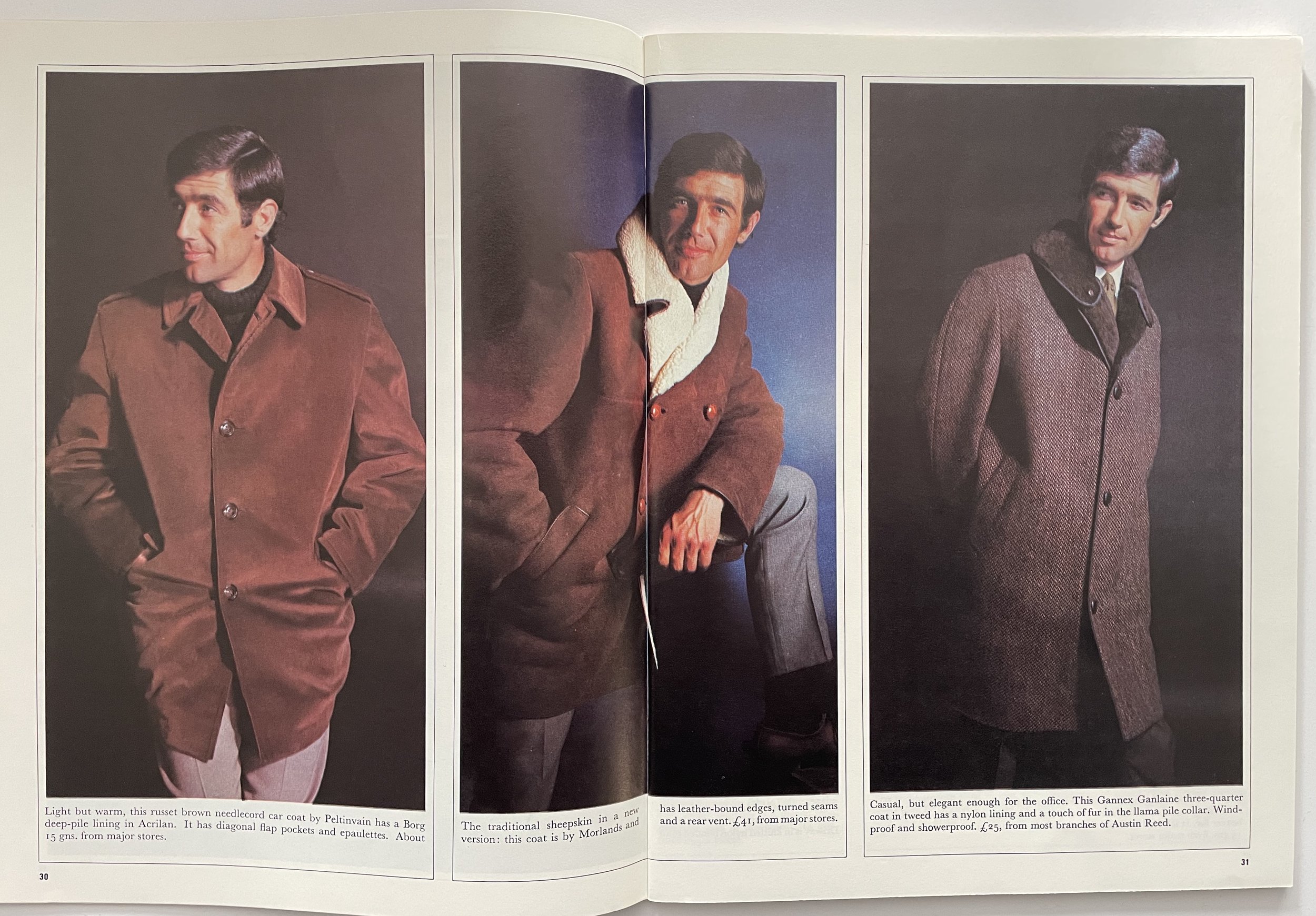
King was a fairly high-end men’s magazine, backed initially by Paul Raymond. It ran from 1964–68 when it was subsumed by Mayfair. I like to think its ideal reader found his surrogate in this male model puting some shape into the latest line in car coats – the well groomed man . . .

This issue also featured a piece and photograph by the great Val Wilmer on Thelonious Monk

Following on the heels of Cohn’s story is a report on drugs and Oxford, there’s no writer’s credit, but I imagine whoever penned this piece had some first-hand knowledge of both Oxford and the scene even if the tone is sensationalist.

The image of the student in mortor board and gown transforming into a bird imprinted on a sugar cube is rather wonderful, blocked and trippy even

What really catches the eye is the description of the dealer working the room with a Bob Dylan record under his arm:

The boy in the combat jacket with a face like the lead singer of the Yardbirds, but with a different intention has found a customer. In the airless bedroom, among the socks, he carefully unrolls a cigarette, watched by the young and eager faces of his new-found friends, and spills the tobacco on to the back of his Bob Dylan record.

The Pusher Men of Oxford . . . but ‘with a different intention’. Rave (May 1966)

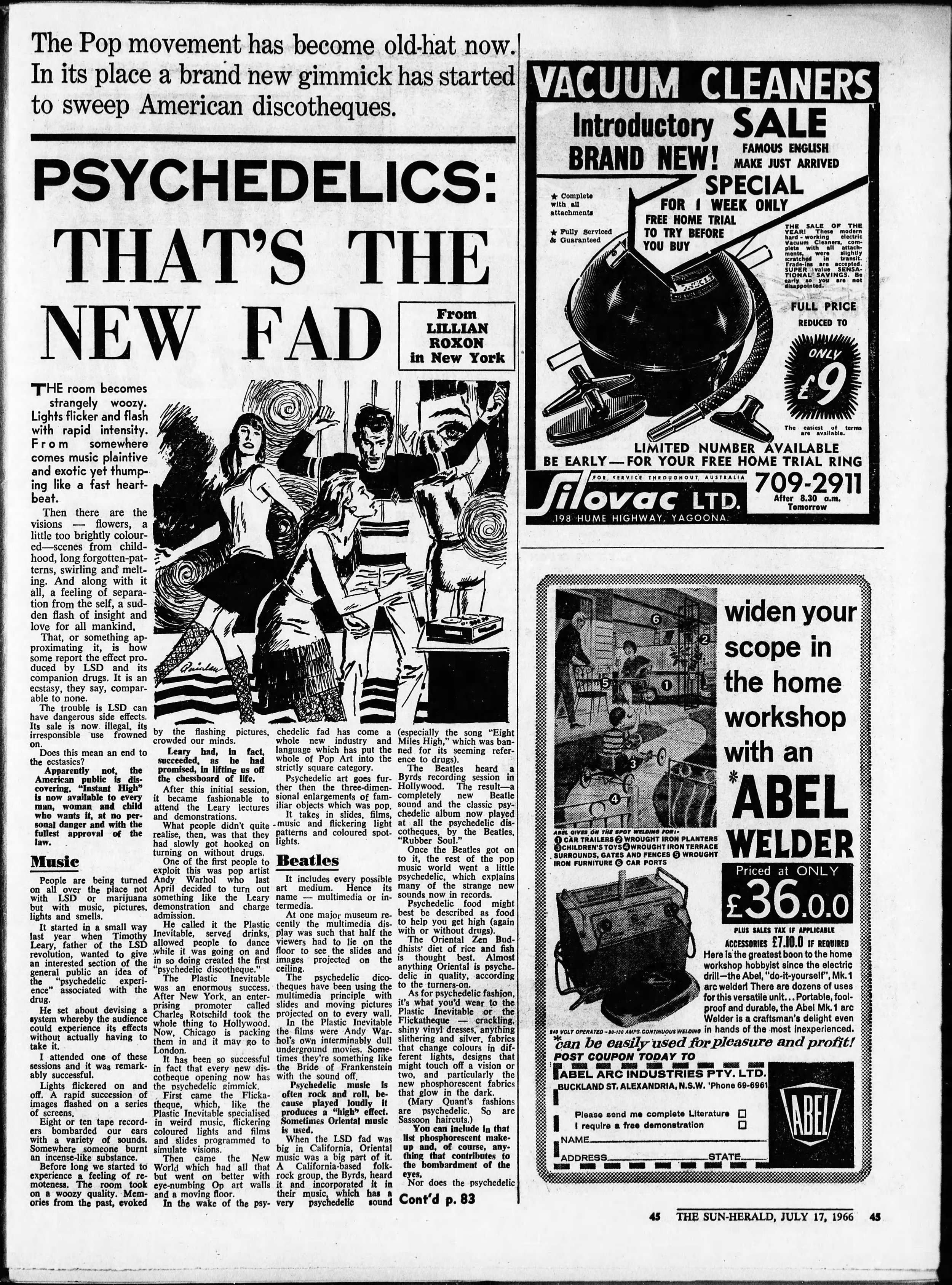
A Biography – Robert Milliken, 'Lillian Roxon: Mother of Rock'

‘If you asked me who was the world’s first pop journalist’, Jim Fouratt told Robert Milliken, ‘in the sense of translating sixties culture, art, fashion, music and politics in a popular way, Tom Wolfe got the credit but I think it was Lillian Roxon. The way she did it was to be in the scene yet objective about it, while Tom Wolfe was around the scene, and reported on it, but never part of the scene like Lillian was. Lillian genuinely loved rock and roll, not just the music but the lifestyle’.

Lillian Roxon: Mother of Rock (2002) is as fine a biography as any I’ve read. From her family’s flight from Nazis to exile and new beginnings in Australia to her death in New York, aged 40, in 1973. In between, Milliken tells the story of how Roxon became one of the significant players in the New York rock scene of the late 1960s and early 1970s, one of the movers and shakers who held court at Max’s Kansas City. Her student years and the Australian bohemian scene in first Brisbane then Sydney and her start in journalism are succinctly, but evocatively evoked, before her move to Manhattan, aged 27, as the 50’s tipped into the following decade.

Australian newspaper culture, the nascent Murdoch empire, tabloid journalism and Roxon’s place in this as an independent, career-minded young woman is portrayed with a deft touch that moves eloquently between historical context and her personal situation, both private and public. Roxon and her friends were great letter writers so Milliken has a treasure trove’s worth of material to draw on, which he adroitly pulls together with her published words and interviews with those who were closest to her as friends and colleagues.

Though it is the third act of her story that most interests me, her family’s history and her early life, especially in Sydney, are crisply and effectively etched to provide a sure sense of who she was and where she came from. I didn’t skip a page.

Her relationships with Linda McCartney and Germaine Greer are given generous space, never overbearingly so, but for me that is all peripheral to her friendship with Danny Fields, Lisa Robinson, Leee Black Childers, Lenny Kaye and the like and her mentorship of young writers like Richard Meltzer, who told Milliken:

Compared to so-called gossip writers, when Lillian wrote ‘scene pieces’ she had a playfulness that was so much more authentic, and never nasty or ill-tempered in the slightest. She wrote from a state of genuine affection for probably a wider range of rock-roll characters than any other rockwriter I have any recollection of. The only exception I can think of was Carole King. She hated Carole King (but then so did most of her colleagues).

In a June 1971 column for the Sunday News, Roxon wrote:

Carole King may have a number one single and a number one album, but I find her as boring as my girlfriends who are always on the phone to me whining about the problems they have ‘communicating’ and having ‘meaningful relationships’. She is like every messed-up neurotic girl you ever had to confront in group therapy. Sincere, certainly, well-meaning, too - a nice girl, not bad looking, super-talented, but exasperating and totally unexciting. You know, of course, what her success means - that rock is going to go into a ‘Dark Shadows’ period. Those moody broody songs about getting it all together and facing the world bravely are going to take over the air-waves, and then what are we going to dance to? The Pathetique Sonata? . . . You can learn more about being a human being from Tina Turner's body language than from all of Carole's fortune cookie philosophising.

That kiss-off line is so beautifully on point. If you can’t dance to Carole King you can pull back the rug and frug along with Ike and Tina, the Ronettes and the Shangri-las:

A contact sheet showing Andy Warhol attending an event at the Action House nightclub in Island Park, Long Island, New York, 4th December 1966. Among those attending are Nico (top, left), her son, Christian Aaron Boulogne (top, centre). The Velvet Underground were on the bill for the evening, along with The Fugs, The Ronettes (second row, far right) and The Shangri-Las.

RONETTES/There are two kinds of lady singers - the angels and the devils. The angels sing ethereal songs in ethereal voices and wear long, loose gowns. The devils sing earthy songs in earthy voices and their gowns fit where gowns should fit. The Ronettes were every teenage boy's dream of a teenage devil in triplicate. Brazen, shapely and without any illusions about men and sex. They were like girlie magazines come alive and set to music. Their song Do I Love You made the boys feel like men. Nothing psychedelic there, just straight from the hip or wherever.

THE SHANGRI-LAS/From time immemorial the bitch goddess has haunted and fascinated man. And so, of course, has the girl next door. The Shangri-las were both, a real bargain for the boy who wanted everything in a girl and the girl who wanted to be that everything. They played it soft and tough at the same time. Their toughest song was Leader Of The Pack. (He was the head of the motorcycle gang and she was his tough mama. Then he dies. Tough mama goes soft, but not for long. You know whoever gets to be the next leader gets her too. Teased hair, doe eyes, ankle bracelet and all.) It was the necrophilia of it all that shocked the adults, not the funkiness of three bitchy white girls who told it straight out that in motor-bike gangs you don't just hold hands. The Shangri-las were akin to Clyde Barrow's Bonnie, in a reversal of the proverbial image, the velvet hands in the iron gloves.


The Ronettes and Shangri-las quotes are from Lillian Roxon’s Encylopedia of Rock. Here she wrote of the Rolling Stones who, unlike The Beatles, ‘had never seen soap and water. And where the adorable little wind-up Beatle moptops wanted no more than to hold a hand, the hateful rasping Stones were bent on rape, pillage and plunder. Well, at least satisfaction . . . No one had ever seen a white man move on stage the way Jagger moved . . .

Right from the start he parodied himself completely but that worked for him, not against him. His lips and no-hips drove every relevant point home; a not-so-distant relative of the Shangri-las’ Leader of the Pack, he laid it on the line. Most of the girls who watched had never before had the word put on them quite so explicitly. It was heady stuff for fourteen-year-old virgins, and others besides.

Milliken spends little time analysing Roxon’s work, he’s content to let her friends and colleagues act as her interpreters. That’s fine, even if it means you have to go back to the work to figure out just why she was held in such high regard. Unfortunately, not much of her writing  is readily available, certainly not in any curated form, and the Encyclopedia is long out of print. If too little of her work is included in the biography (there are some selected writings at its end but these are mostly from the Encyclopedia alongside a few key pieces on the women’s movement, Germaine Greer and Creedence Clearwater Revival). What’s also missing is a more detailed account of how she spent her time and what she wrote about in the last five years of her life, her trips to London, her radio show appearances and her support of third generation rock artists like Iggy and the Stooges, David Bowie, Marc Bolan and the New York Dolls all demand a fuller account.

Even at this late date, I’m going to take a position on defining Lillian Roxon as the ‘Mother of Rock’. It’s a misnomer, the maternal diminishes and marginalises her activity to one of a nurturing figure rather than a full participant with an original and unique voice that is worth listening to in its own right. That said, Milliken has written a studiously researched and eloquent biography. It’s an admirable achievement. Someone, however, needs to supplement Milliken’s book with a reader that genuinely covers the range of her outputs.

Last words go to Lillian Roxon, on moving into new accommodation she had it fumigated to exterminate the pests that Germaine Greer had, to her chagrin, suggested defined her:

I now live alone with no colonies of roaches and one life size poster of Iggy Stooge mother naked to cheer me up.

Richard Bernstein Iggy Pop (1970) edition of 100 silkscreen on paper. 42” x 32” Is that ‘life size’? Yours for $5K from Sotherbys [HERE}

Iggy and the Stooges at Max's – Rock Scene Reports

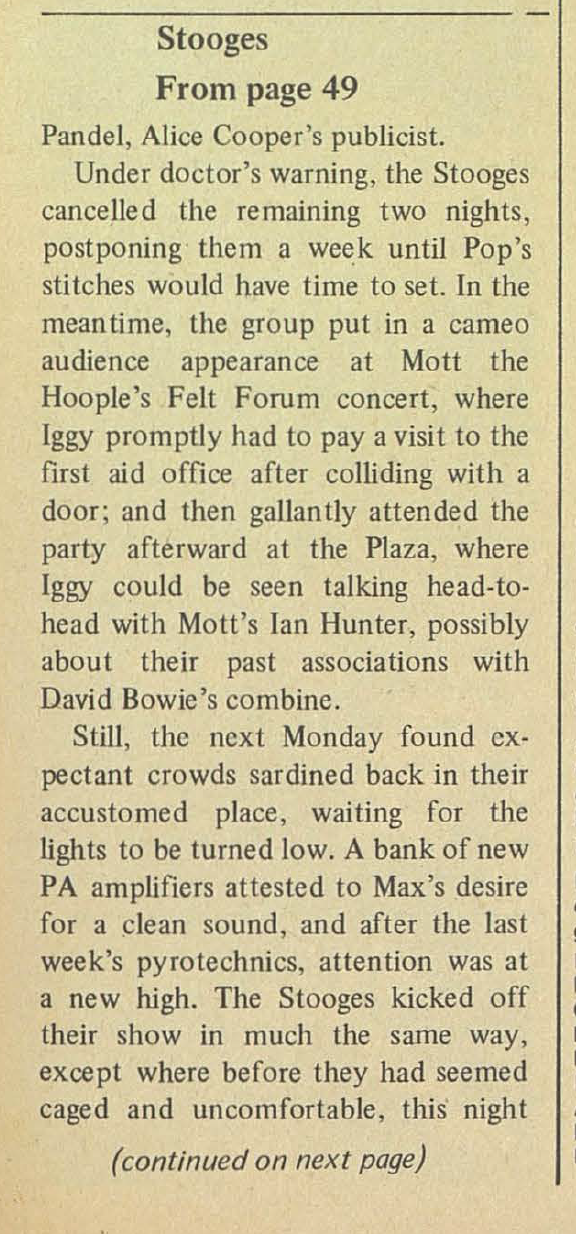
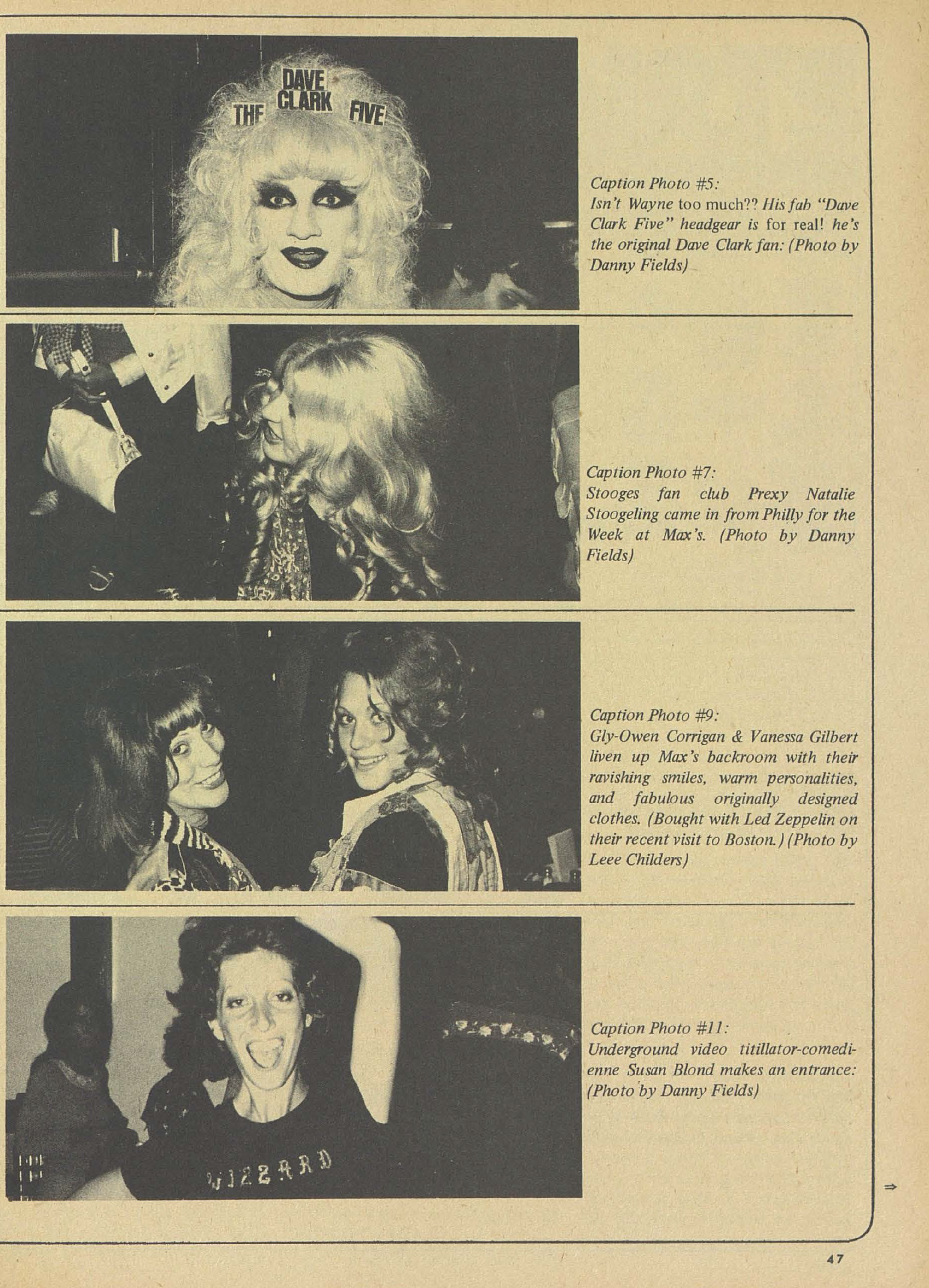
With the New York Dolls on the cover, Rock Scene (March 1974) ran large with the Stooges’ Max’s Kansas City gigs on July 30–31st and August 6–7th, 1973 (the mag was bimonthly which meant it went to print two months or more before the the date line on its cover).

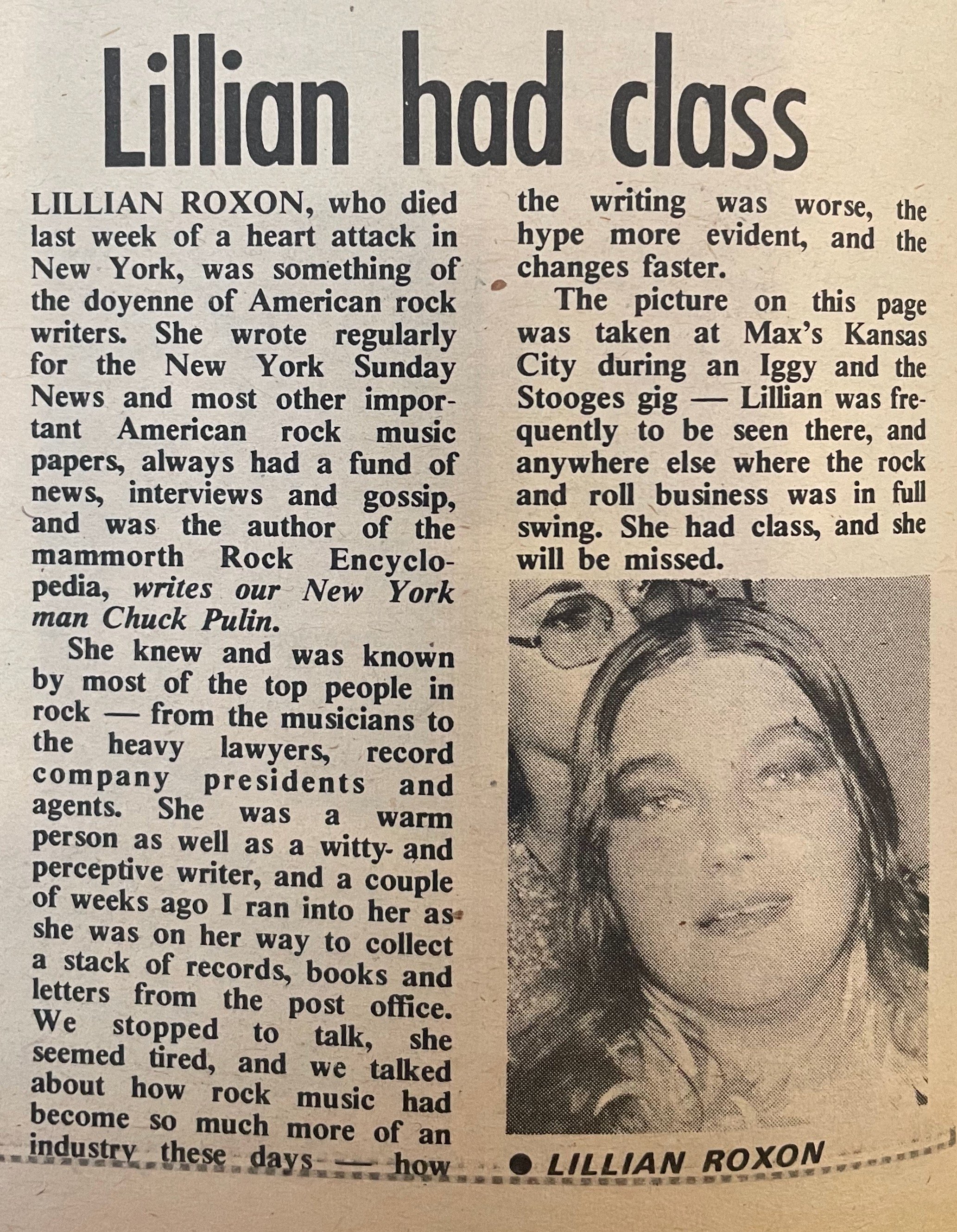
Lillian Roxon’s death was reported along with a photograph of her kissing Lenny Kaye. They were both at Max’s for The Stooges:

It was a night of feathers and glitter, and crowds of people coming to hear rock and roll. Lillian was working, that’s why she was there – but she knew it was An Event too. That’s why she wore her feathers and makeup.

Lenny Kaye wrote up the report of the gig

Celebrity nights . . . the first two were marred by poor sound, for the second two it was ‘near perfect’

It was almost as if the band had realized that they’d gone as far as they could go in one particular direction, the oft-predicted way of on-stage suicide not to be theirs; they drew back from the edge, wary and knowledgably watchful, all senses alert.

Fred Kirby pictured top right second down filed a report for Variety, published August 8, 1973.

Billboard (August 25, 1973)

Iggy’s turn to play the on-looker . . . at Mott the Hoople/New York Dolls afterparty following their show at Felt Forum, Madison Square Garden (August 3, 1973) where Iggy walked into a glass door, hence the sticking plaster . . .

Sounds (August 25, 1973)

also from Sounds (August 25, 1973)

A complete run of Rock Scene can be found HERE

Amphetamine Academia – Ugly Things Review by Dave Laing

I’ve been a regular reader of Ugly Things since 1994, issue 14 when The Birds were the cover stars, so it feels a bit strange and kinda wonderful to find myself in #60 spread across 4 pages. Dave Laing reviewed Pin-Ups 1972 and interviewed me.

Momentous . . . an academic treatise that reads with the manic energy of an early Lester Bangs . . . Opposing views of authenticity, the underground’s clash with the mainstream and art’s clash with artifice and commerce, these are things that went into shaping the music, and Stanfield explores them with an addictive enthusiasm. . . Pin-Ups 1972 will leave you breathless from the number of different ways it comes at the music and reeling from the sheer number of points it makes.  Together with Stanfield’s A Band With Built-In Hate, it presents what I consider to be a new way of writing – amphetamine academia – about what is some of the most exciting music ever made. I can’t recommend it enough.

Dave Laing

These days with inflated shipping charges, Ugly Things is often hard to find here in the UK, but recently I’ve been getting mine from Juno (here). The mag’s home site is here

That Very Bizarre New Group Called The Dolls – Lillian Roxon

Final part of my Lillian Roxon excavation . . . here she sells the New York Dolls

Sunday News (June 4, 1972)

One of the earliest published notices for the Dolls, which prededed their run of 14 Tuesday night engagements at the Mercer Arts Center begining on June 13th (according to From the Archives here)

Sunday News (July 30, 1972)

Lillian is in London to cover Bowie in Aylesbury and Lou and Iggy in King’s Cross, she also takes time out to note that Britain’s top music paper, Melody Maker, have dedicated a full page to the Dolls, unsigned yet trailed as being ‘the best young band ever’. She agrees . . . Here’s Roy Hollingworth’s piece:

Roy Hollingworth Melody Maker (July 22, 1972)

Sunday News (September 3, 1972)

‘thinnner and younger and punkier . . . The manic audience loves them . . .The music is the kind that makes parents crazy. Early push-back-the chairs-and-dance rock-and-roll . . . Everyone and his mother loves the Dolls’.

Sunday News (September 17, 1972)

New Yorks Dolls part of the Rock ‘n’ Rouge clique

Sunday News (September 24, 1972)

David saw the Dolls and he can’t stop talking about them . . .

Sunday News (May 6, 1973)

As with the UK music papers, Lillian plays to the gallery, some of her readers might hate the Dolls but they can’t stop reading about them and letting her know . . . ‘Most of the people you write about are so unimportant in the rock world. For instance, Marc Bolan and David Bowie’.

Sunday News (August 5, 1973)

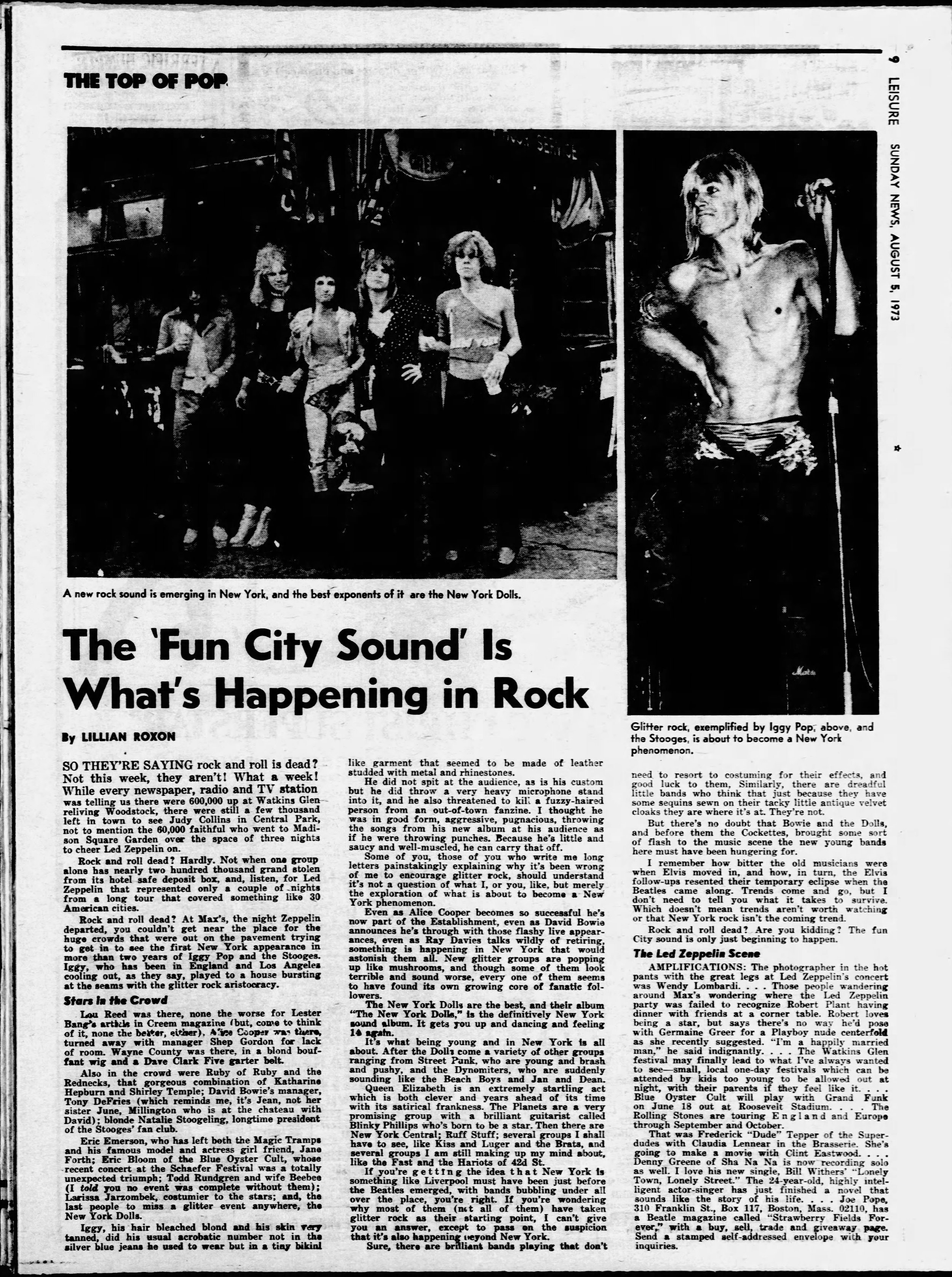
Lillian’s final despatch . . . Rock n Roll is not dead . . . ‘The New York Dolls are the best, and their album “The New York Dolls”, is the definitively New York sound album. It gets you up and dancing and feeling 14 again’. She was not alone in that sentiment.

Newsday Sunday August 19, 1973. Dave Marsh rounds up the new acts making the scene in New York. Lillian Roxon is pushing the Dynomiters, who I’ve never heard of but then neither have I seen Street Punk listed before (Roxon drops their name in her Australian column, Luger sound familiar (Iggy might produce them) but not New York Central (produced by Lennon!!!). The rest I know about . . . You know, Kiss . .

Rock Scene (March 1974) ran a very similar feature on New York’s up n’ coming that featured much the same line up, but with more pictures. Here’s Street Punk . . . bit of a misnomer if you ask me . . .

NME June 7, 1975. Looking like a bunch of glitter-era hangovers, Lisa Robinson moves the tale of New York’s wannabes toward centre stage: ‘What else is new? Well, the Ramones for one . . .’

Lillian Roxon, Falling For Those Pale Skinny English Boys: Bowie and Bolan

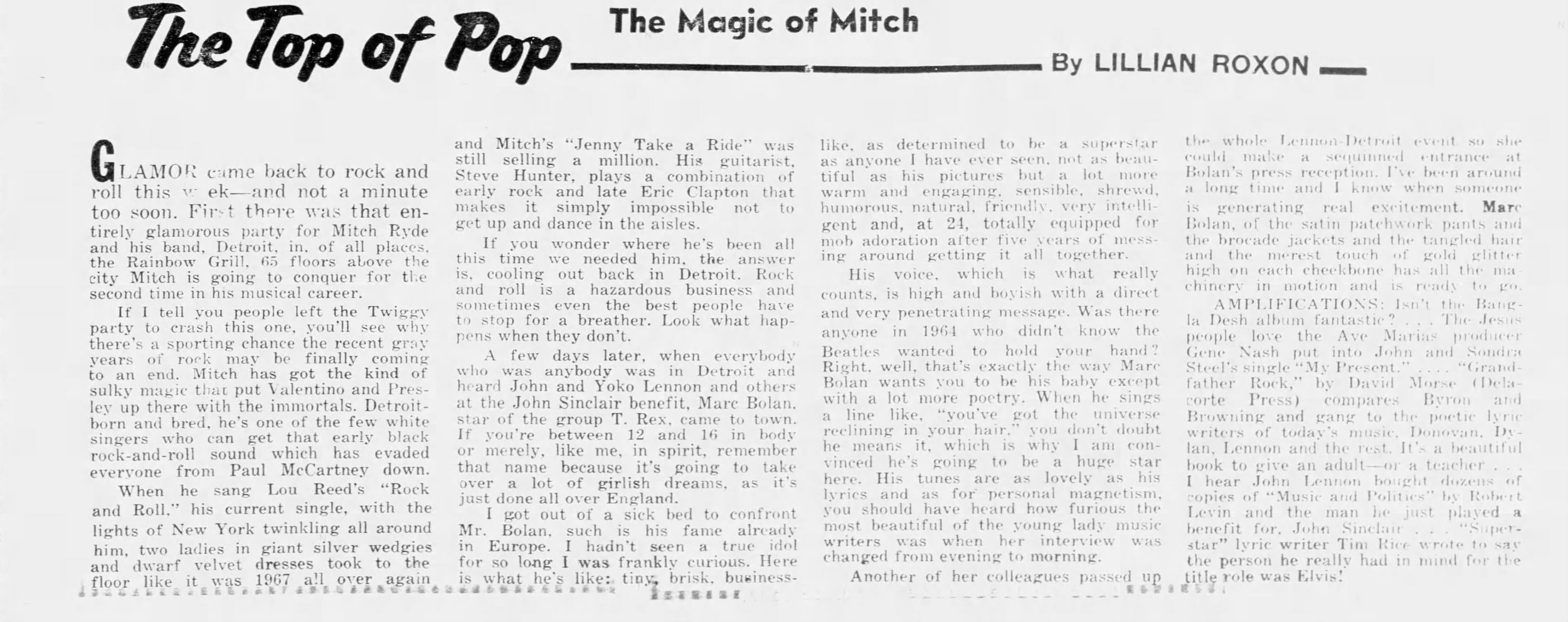
As 1972 moved into the Spring, Lillian Roxon had fallen in love again with pop and the teenage dream. Marc Bolan was her first true love of the new season.

Sunday News (December 19, 1971)

Climbing out of her sick bed, Lillian sets off to meet her new teen idol. She is enchanted . . .

Sunday News (February 20, 1972)

She’ll make at least two trips to London in 1972, in February she was part of the media circus to witness Bowie’s coming out as Ziggy Stardust. The Garbo look has been replaced by short-hair and Star Trek jumpsuits. . . ‘restoring a little of the stud image he’d lost’. The Lou Reed influence on Bowie is pushed to the fore

Sunday News (February 27, 1972)

When in London, go shopping . . . This represents perhaps the earliest US press appearance of Malcolm McLaren and Vivian Westwood’s Let It Rock. Lillian calls it Paradise Garage, which had ceased trading in November 1971. The confusion is understandable, as Paul Gorman reminded me the Let It Rock sign was not in place until March ‘72.

The salesmen have long hair, all right, but it is greased back into high shiny pompadours. When they’re not wearing motor cycle jackets they sport authentic drape shape coats with velvet lapels.

Sunday News (March 5, 1972)

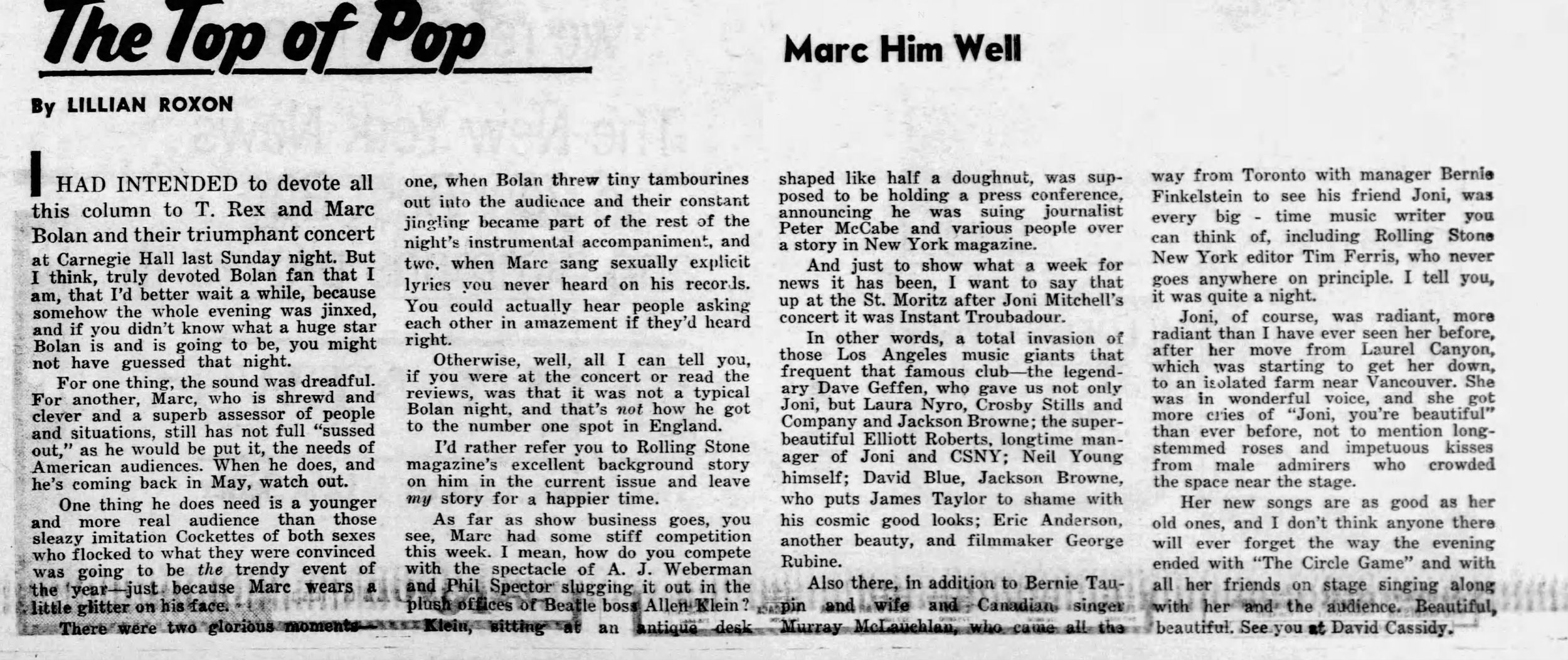
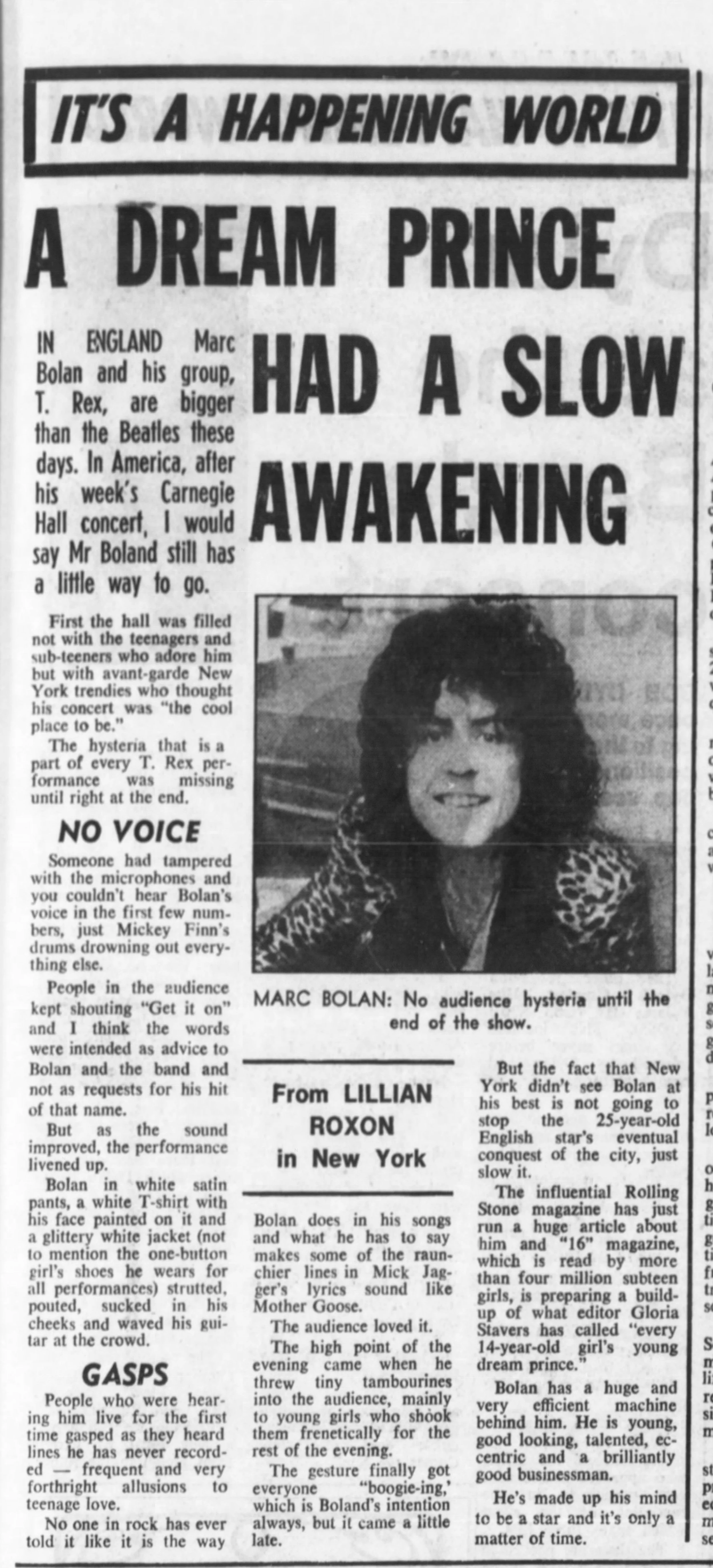
Bad sound and the wrong audience spoilt Lillian’s enjoyment of T. Rex’s Carnegie Hall gig. In her two accounts of the show she mentioned Marc ad-libbing sexually explicit lyrics: ‘You could actually hear people asking each other in amazement if they’d heard right’. So, what was he singing? I need to know.

Sydney Morning Herald (March 5, 1972)

Sunday News (June 18, 1972)

In June she interviews Bowie during a 3 day promotional visit to NYC. Both watch Elvis. Bowie plays on the idea of being a fabricated pop star, imagining a doll in his own image with hair that grows and that can say things like ‘I love you’ and ‘I like to dress up’. Lillian hopes it will come with the full Ziggy wardrobe.

Sunday News (July 30, 1972)

And then she’s part of the press junket arranged for American critics with a Bowie show at Friars, Aylesbury and the Lou Reed and Iggy and the Stooges sets at King Sound, King’s Cross.

Sunday News (August 6, 1972)

Sunday News (September 24, 1972)

Bolan is back and playing at the Academy of Music, but it’s still not working:

this is a man who should never be allowed to work without at least two hundred screaming young girls crammed into the first ten rows . . . Playing to the torpid mob at the Academy of Music, he was like Raquel Welch trying to do a strip for the Daughters of the American Revolution. Namely, not fully appreciated.

Meanwhile, Bowie is about to make his debut US appearance . . .

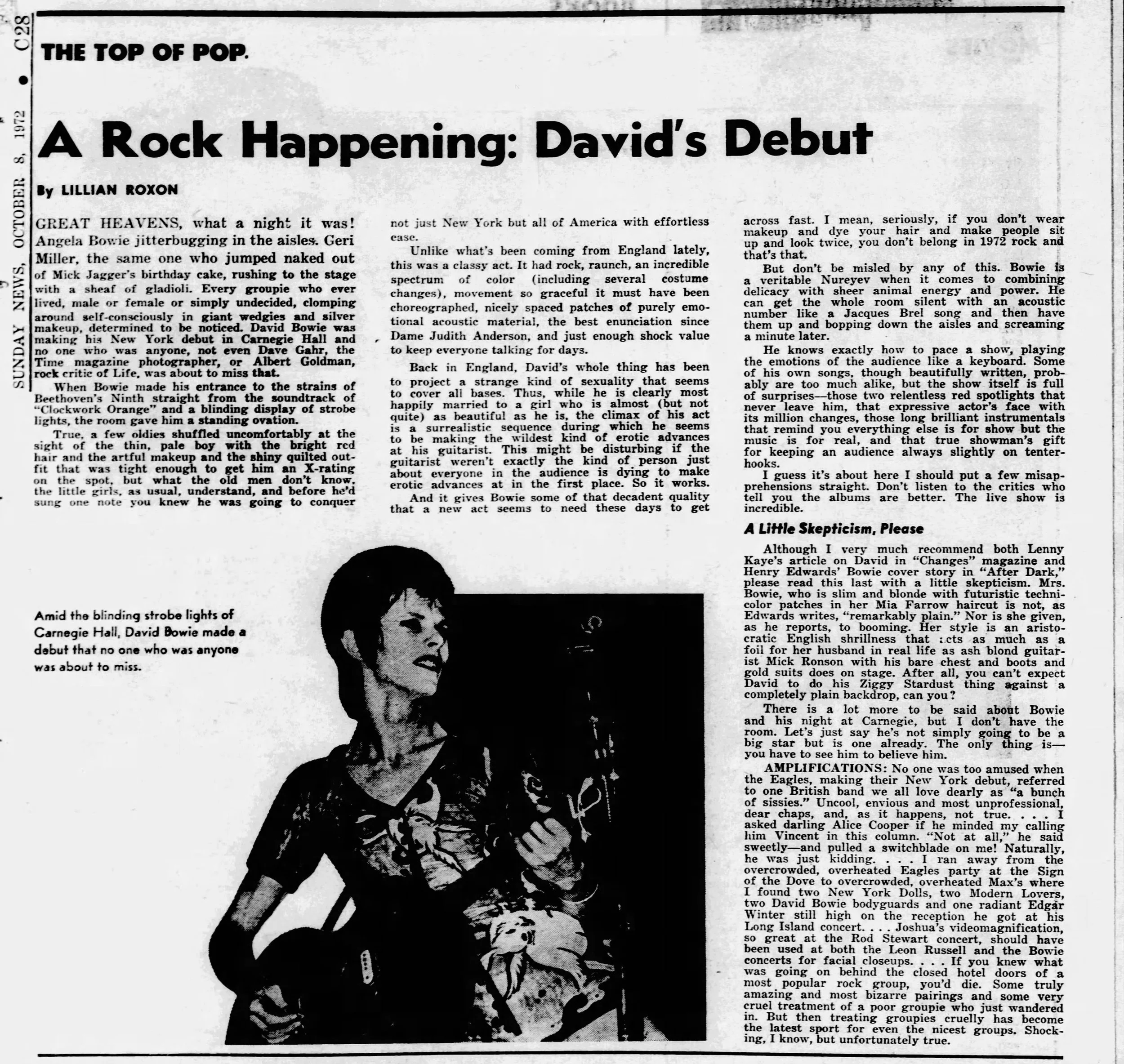
Daily News (September 30, 1972)

A star is born . . . whose ‘carefully stylized movements give us an updated (though deceptively frail) ‘70s version of the ‘50s teenage hood’.

Sunday News (October 8, 1972)

Sydney Morning Herald (October 8, 1972)

Sydney Morning Herald (December 10, 1972)

Lou Reed given the ultimate plug for his forthcoming Transformer . . . evil

The sexiest thing since Mick Jagger . . . says Lillian Roxon

and that would be Iggy Stooge . . .

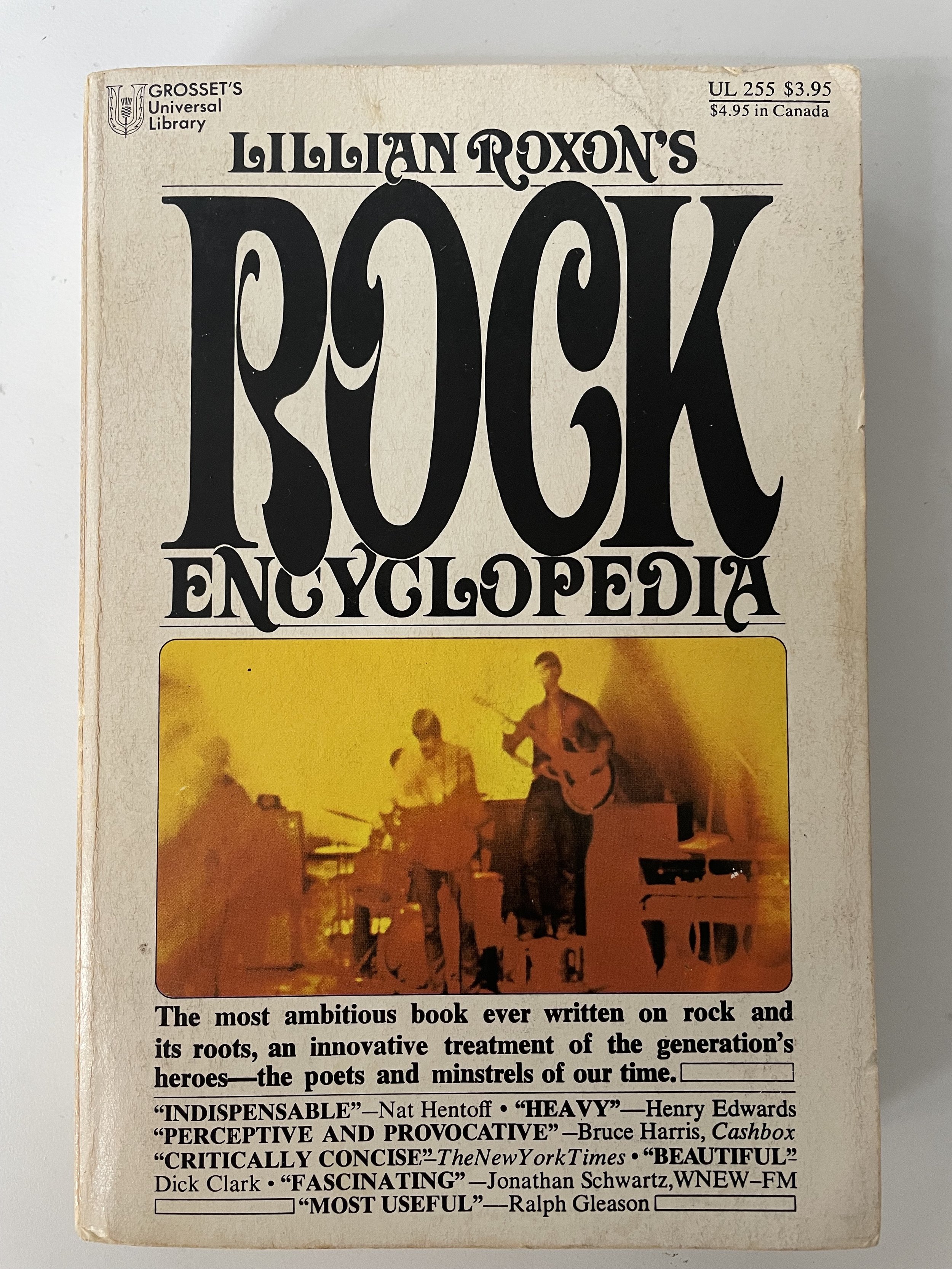
I recently picked up a copy of Lillian Roxon’s Rock Encyclopedia, the 1971 paperback edition with a new, very short, introduction that tried to capture how much had happened since the book was first published in 1969. CSNY had formed, Led Zeppelin had become the most popular band in the world, The Beatles had quit and the Jackson Five filled Madison Square Garden (and so did Grand Funk Railroad), but the most significant event was that Iggy Stooge had emerged and she was smitten ‘. . . with the sexiest thing since Mick Jagger’.

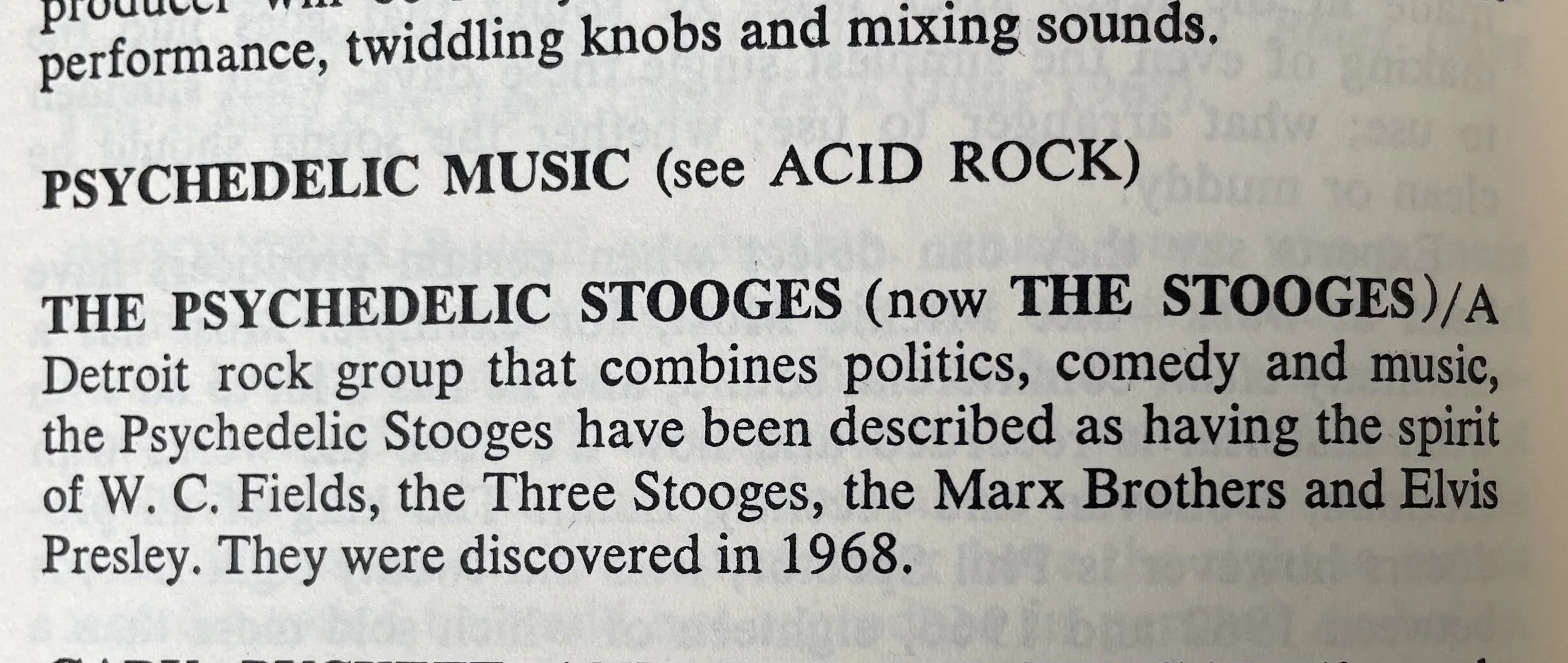
The Encyclopedia’s 1969 entry for The Stooges is easily missed as it falls under their longer name ‘The Psychedelic Stooges’. That these unknown Detroit hoodlums get an entry while bands with a history and a profile, like The Pretty Things, don’t make the grade might suggest that her friend, and the explorer responsible for discovering the them in 1968, Danny Fields was getting the hype in early.

Intrigued, I went looking for some other things Roxon had written about The Stooges. She was the New York correspondent for Sydney Morning Herald so I trawled through the paper’s archive, which gave me little more than the two articles Per Nilsen cites in his estimable Iggy & The Stooges On Stage 1967–1974. Other than those two, the band made a few brief appearances in the paper. Roxon used The Stooges to illustrate one of the directions contemporary music was heading: the theatrical, shock rock approach shared with Alice Cooper. There’s a note that Astor records have picked up the license for Elektra and will be releasing the Stooges album, and a review of Fun House by Michael Symons. The ‘Some Pop Primitive’ in the headline for the review refers not to the ‘world’s most frantic band’ but to Melanie . . . go figure (see below at the bottom of this post).

Both her Australian reviews of the live Stooges experience are from Electric Circus gigs (October 23, 1970 and May 14 & 25, 1971). A wider search also revealed an audio recording of a two minute syndicated review of the 1971 shows, ‘Can A Boy Named Iggy Be The Silver Messiah?’ which is just a joy to hear. (radio here)

Sydney Morning Herald (November 1, 1970)

His whole idea is to jolt the audience into a state of fear and shock. When he sings to a girl, or to the audience, he does not do it caressingly but with anger and violence. The girl doesn’t know whether she wants to mother him – or back away. Watching the indecision is part of the sadistic thrill of being in The Stooges audience . . .He seems to embody the violence around in America today.

Sydney Morning Herald (June 6, 1971)

The Stooges are definitely the darlings of the avant garde this year. It must be the spitting.

 Other than her contract with the Herald, Roxon also penned a weekly column, ‘The Top Of Pop’, for New York’s Sunday News. It’s a great primer to the scene circa 1971–73. Iggy received a fair number of mentions in the sidebar, ‘Amplifications’, along the lines of ‘Iggy Stooge are you serious about making a movie with Andy Warhol?’ (10/71), Iggy of the Stooges joining Lou Reed and the Flamin’ Groovies in London and references to seeing Bowie in Aylesbury with a strong suggestion that she joined other critics that night at the King Sound gig: ‘Detroit’s Iggy Pop wears his hair sprayed silver off stage. . . (with a well worn Marc Bolan T-shirt) . . . glove-tight studded silver pants, eyeliner and black lipstick.’ (July 30, 1972). All echoing the previous week’s column:

Sunday News (July 23, 1972)

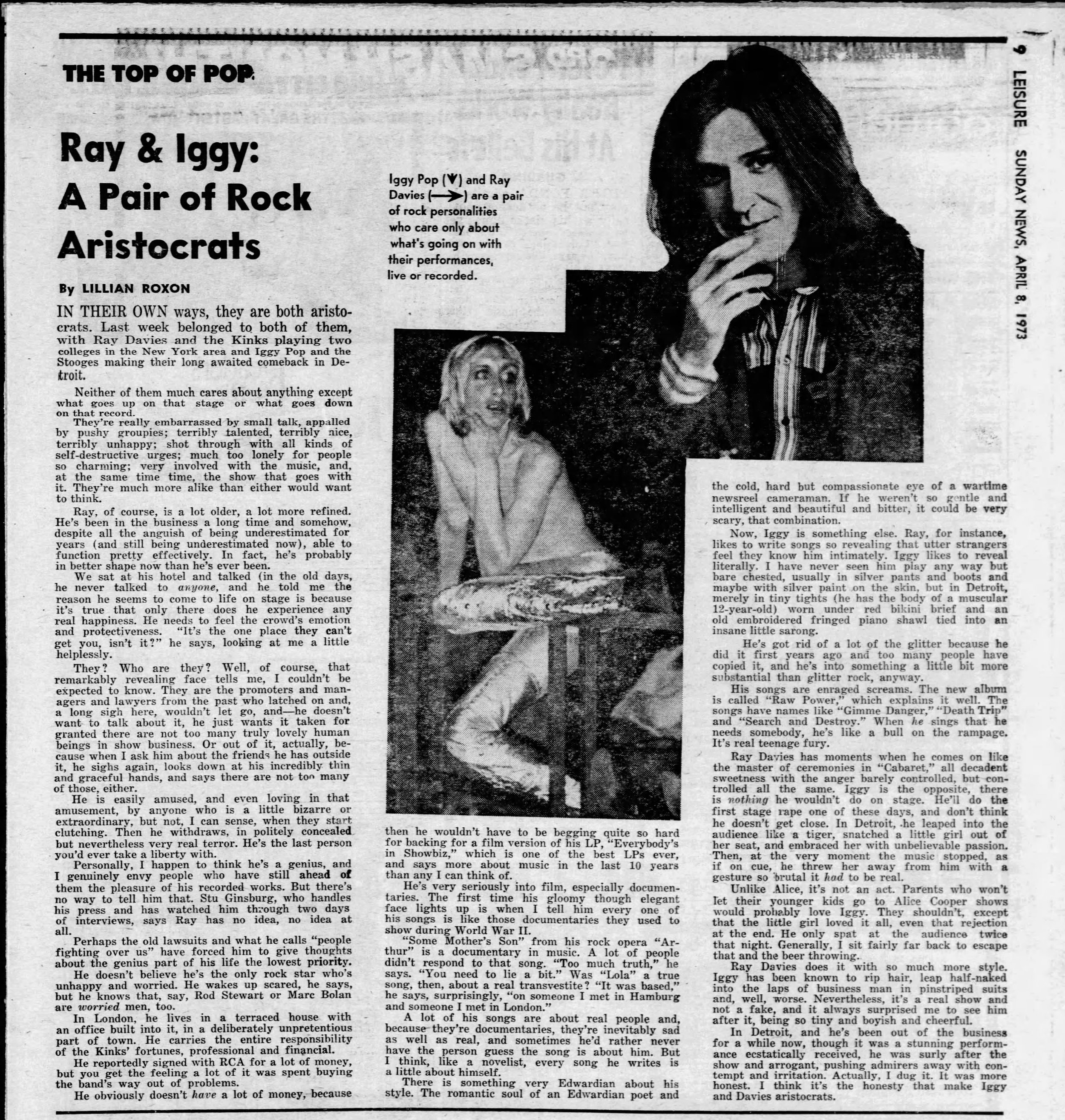
Her first proper review of The Stooges for the Sunday News was of their return, after London, to their home town for a gig at the Ford Auditorium (March 27 1973). Roxon matched her impressions of the Detroit gig with, her longtime favourites, The Kinks in New York. She thought Ray Davis and Iggy were a ‘pair of rock aristocrats’. A strange combination, but they shared an honesty in their art that she appreciated whatever the differences in their performance styles and music.

Sunday News (April 6, 1973)

Gone in Detroit was the glittered torso of the Electric Circus gig, when she last saw Iggy. She wrote, ‘too many people have copied it, and he’s into something a little more substantial than glitter rock, anyway.’ Raw Power is a recent release, a collection of ‘enraged screams’ and on stage, in red bikini briefs beneath ‘an old embroidered and fringed piano shawl tied into an insane little sarong’, Iggy is still, as at the Electric Circus, breaking through the fourth wall, sitting in the lap of audience members, dragging young women on to his podium: ‘there is nothing he wouldn’t do on stage. He’ll do the first stage rape one of these days, and don’t think he doesn’t get close’.

Roxon was an enthusiastic champion of Bowie and Bolan, and helped boost the New York Dolls right from the start. When The Stooges made their return to New York at Max’s Kansas City in July/August ‘73 she covered it along with a review of the first Dolls album

New York Sunday News (August 5, 1973)

A week after that post and three days on from the final Stooges’ gig at Max’s she was dead. Iggy and the Stooges and the New York Dolls her final story.

New York Sunday News (August 11, 1973)

Sydney Morning Herald’s Fun House review

Sydney Morning Herald (December 19, 1970)

Go-Karting with The Stooges' Ron Asheton

Keith Moon and Ron Asheton both liked to wear t-shirts, but while The Who’s drummer went through a whole catalogue of POP designs, The Stooges’ guitarist only favoured the one. His shirt of choice featured Stroker McGurk tear-arsing about on a go-kart: ‘fun on wheels – for everyone!’. Tom Medley was the cartoonist, his main gig in the fifties was with Hot Rod magazine (see here). I suspect Ron bought quite a few Stroker T’s, cos he wore it from at least the Autumn of ‘68 to the Summer of ‘72. As a teenager my shirts rarely survived two washes . . .

Outside the Stooge Manor House, September 1968. Photo Ron Richardson in The Stooges: The Authorized and Illustrated Story

Iggy steals Ron’s shirt: The Stooges at the Fifth Forum, July 1969. Photographs by Peter Yates (from here)

Out On The Street: Ann Arbor, 1969. Photo Glen Craig in Total Chaos: The Story of The Stooges

from Ed Caraeff Iggy and the Stooges: One Night at the Whiskey, 1970

Fun House sessions by Ed Caraeff. May 23, 1970

Cincinnati Pop Festival, 13 June 1970. Photo by Tom Copi

King Sound, Kings Cross, London July 15, 1972. Photo Mick Rock

To be continued . . . .

Glam! When Superstars Rocked the World, 1970–74

Mark Paytress is among the best sleeve note writers, just a notch or two below the master, Bill Millar. I’ve lost count of the times I’ve bought a new package of T. Rex recordings because I wanted, most of all, to read what he had to say. The duplication of Bolan recordings in my collection can take care of themselves but Paytress, despite the familiarity of the material he is annotating and contextualising, is never repetitious. His observations are diamond bright and sharp. He never resorts to cliché. He has always found something new to say and a novel way to approach his story. His writing has added greatly to an appreciation of Bolan’s music.

His Bolan biography stands head and shoulders over any other, by whatever measure Paytress is a fabulous writer and a great story teller.

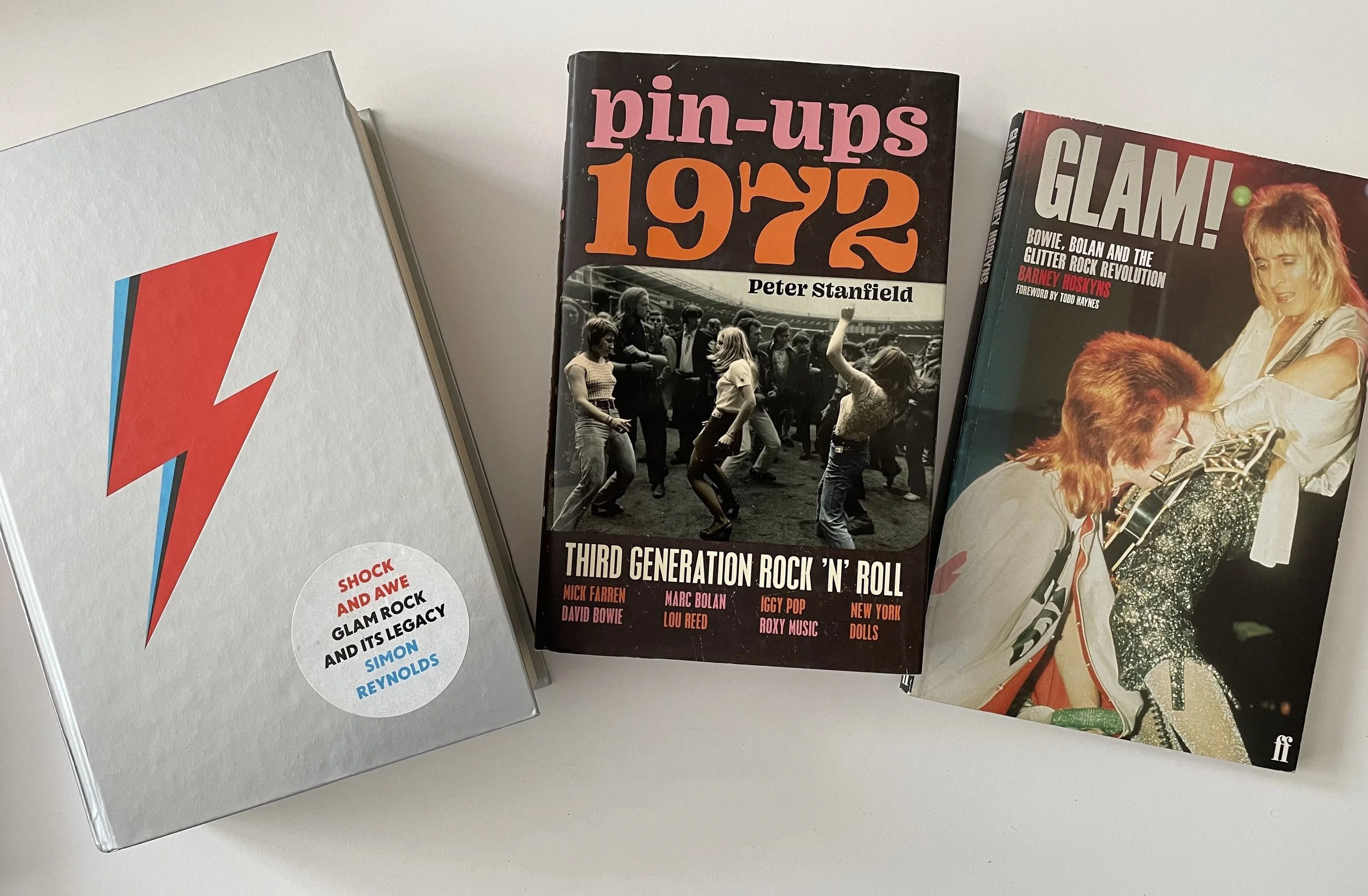
Glam! When Superstars Rocked the World, 1970–74 doesn’t disappoint. The topic is as familiar as any trend in post-first generation rock ’n’ roll – you already know the story and all its twists and turns. With Glam!, Paytress has not been as inclusive as Simon Reynolds with Shock and Awe (2016) but he is considerably less exclusive than Barney Hoskyns was with Glam! (also with an exclamation mark that promises MORE!), published in 1998 to coincide with Todd Haynes Velvet Goldmine, and my own Pin-Ups 1972: Third Generation Rock ’n’ Roll (2022). The key figures are of course, Bolan, Bowie and Roxy Music, but he gives generous space to Roy Wood, Slade, Rod Stewart, Elton John, Alice Cooper, Mott the Hoople, Gary Glitter and, I think, most significantly to The Sweet.

Extensively illustrated with a superbly curated mix of agency photographs and pop ephemera, especially the long lost essential Seventies’ adornment of the faux silk scarf, a fashion accessory that crossed-over effortlessly with football culture (I yearn for its return). Glam! is a joy to idly flick through and a pleasure to read. Paytress holds to a rough chronology, beginning with the withdrawal of the promises of the Sixties with the Isle of Wight festival.  That event is figured as a moment of death and rebirth: Hendrix’s overdose and festival dj Jeff Dexter playing, again and again to the huddled masses, a test pressing of ‘Ride a White Swan’. The book’s coda refigures the trope with the death of Bolan and a rebirth with punk.

In between, even the most jaded of readers will find much to amuse, ponder over and debate. You might argue that, because Paytress is telling the story, T. Rex has been given the dominant role. This might be true, but I also think he makes the case for continuing to weave Bolan into the narrative after the rise of Ziggy. The fall of T. Rex is as important as any contender, any bright new challenger on the scene. It also works quite brilliantly alongside the travails of The Sweet: their acceptance that being the puppets of Mike Chapman, Nicky Chinn and producer Phil Wainman will give them the success they couldn’t earn on their own and their bid for autonomy, just as the train they rode on was about to run out of track, is the stuff of pathos. Someone really does need to write a pop history of The Sweet, Chinnichap and the British 70s pop machine. . . Step up, step up right up!.


Footnote:

I’ve always cherished Bolan’s wilful, creative acts of plagiarism in his song writing, ‘Beltane Walk’ as a rewrite of Jimmy McCracklin’s ‘The Walk’ and Howlin’ Wolf’s ‘You’ll Be Mine’ for ‘Jeepster’ being the two most egregious or brilliant of the many. Mark Paytress has brought a new one to my attention, Johnny Burnette Trio’s ‘Honey Hush’ as the basis for ‘Jewel’, the second track on side one of the first T. Rex album. Play the two recordings back-to-back to know this to be true, but also to realise just how inventive Bolan has been in making an abstract out of his source material. Marc Bolan – pop genius.


This beautiful original courtesy of The Seth Man